

A case study in manufacturing confidence between strangers
In 2008, the notion of sleeping in a stranger’s spare room sounded… risky. Hotels owned trust by default: front desks, brand standards, and credit-card rails. Airbnb’s challenge wasn’t just writing code; it was making an unfamiliar behavior feel safe. As trust scholar Rachel Botsman puts it, consumers must “climb the trust stack: first the idea, then the company, and finally the other person.” (ideas.ted.com)
Seventeen years later, the scale is hard to ignore. Airbnb reports over 5 million hosts who have welcomed more than 2 billion guest arrivals globally; in Q2 2025 alone, guests booked 134.4 million nights and experiences and revenue reached $3.1 billion. That kind of volume only happens when a product makes a new behavior feel normal-when it manufactures trust.
This post breaks down the product and growth moves that helped Airbnb do exactly that-framed as PM lessons you can apply to your own marketplace.
PM Lesson #1: Solve the Two‑Sided Problem by Doing the Unscalable
The earliest growth challenge was the classic chicken‑and‑egg: no guests without listings, no listings without guests. Y Combinator’s Paul Graham advised the founders to “do things that don’t scale.” In Airbnb’s case, that literally meant flying to New York, going door to door to recruit hosts, and helping them improve their listings. (Paul Graham)
Brian Chesky later summarized the mindset YC drilled into them: start with the perfect experience for one person, then scale it to “100 people who love us.” He called it “the best piece of advice we’ve ever received.” (Y Combinator)
That mindset mattered because supply quality, not just supply quantity, is what unlocked demand. When the founders sat with hosts in New York, they noticed most listings had poor, dim photos. So they rented a high‑end camera and shot the listings themselves, then built a programmatic way to deliver professional photography at scale. The results were measurable.
Data point: When Airbnb rolled out its free professional photo service (initially a pilot in 2010), the company told Fast Company that listings with pro photos were booked 2.5× more frequently and earned about $1,025 more per month on average. (Fast Company)
The takeaway for PMs: if your marketplace is cold, go hands‑on with the constrained side (usually supply). Improve quality first-even if your “tool” is a DSLR and a subway pass.
PM Lesson #2: Build the Trust Stack into the Product
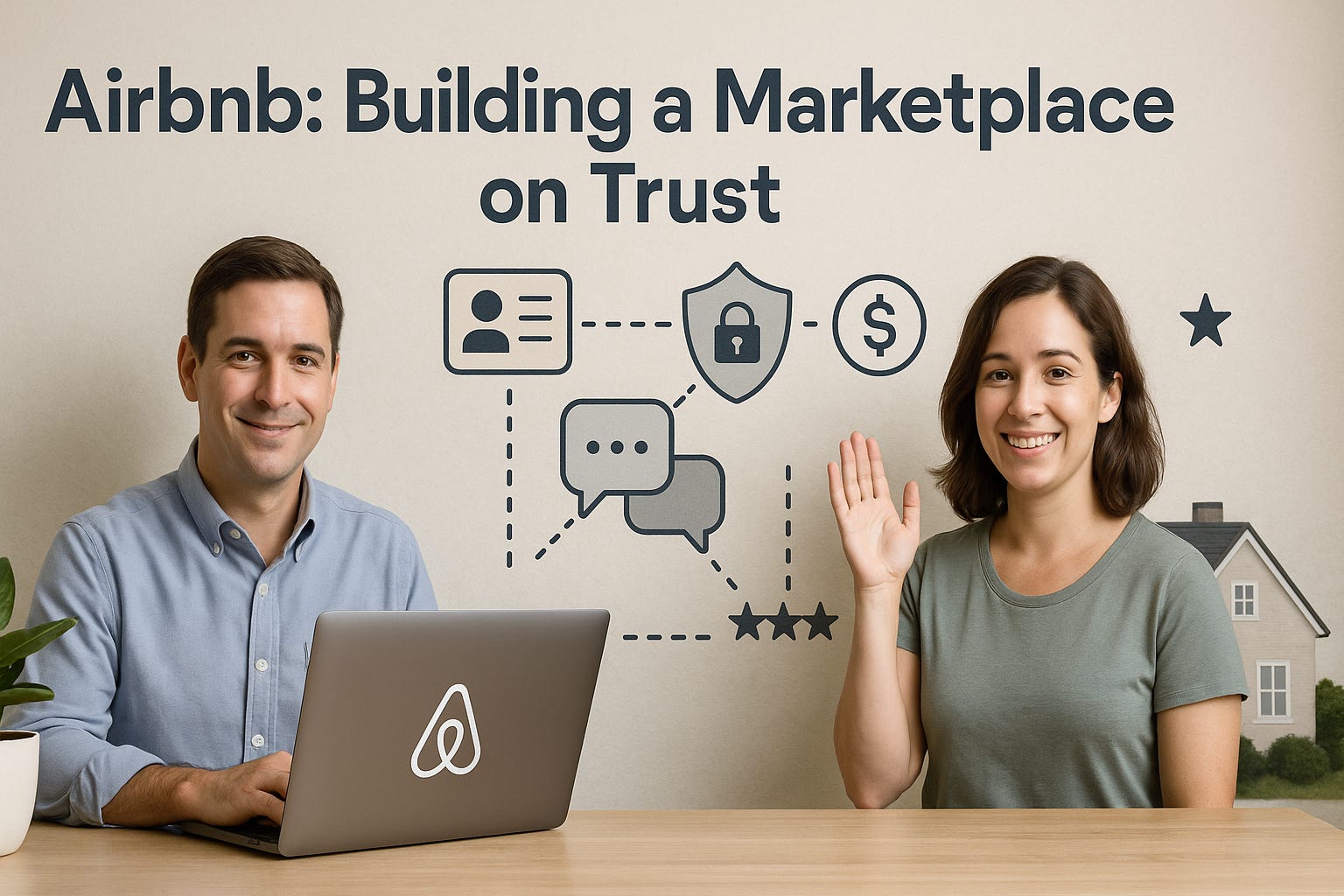
Botsman’s “trust stack” is a helpful lens for marketplace features: users first trust the idea, then your platform, then each other. Airbnb operationalized this with a layered system. (ideas.ted.com)
1) Verified identity & profiles. In 2013, Airbnb launched Verified ID, linking online accounts to offline identity via a government ID scan or knowledge‑based verification. The goal: reduce anonymity and help both sides feel like they’re dealing with “real people.” (TechCrunch)
2) Safe, on‑platform messaging. Pre‑booking communication happens inside Airbnb; contact info is suppressed and off‑platform payments/communications are against policy. This both deters scams and preserves context for customer support. Phone numbers are only revealed after a reservation is confirmed. (Airbnb)
3) Reliable payments and escrow‑like flows. Airbnb doesn’t release host payouts until 24 hours after check‑in, giving guests time to confirm that what they booked matches reality. That tiny delay-invisible to many users-creates an important safety buffer. (Airbnb)
4) Two‑way, double‑blind reviews. Airbnb’s review design is small but mighty: both parties have 14 days to review; neither can see the other’s review until both are submitted (or the window closes). This reduces retaliation and drives more honest participation-a core social proof loop for every future booking. (Airbnb)
5) Visible reliability signals. Programs like Superhost (high rating, low cancellations, strong responsiveness) improve matching by making quality legible at a glance. It’s a trust shortcut for guests and an incentive system for hosts. (Airbnb)
6) Platform‑level protection. Today’s AirCover for Hosts includes guest identity verification, reservation screening, up to $3M in damage protection, and $1M in liability insurance. Safety nets won’t create trust by themselves, but they reduce the perceived downside risk of participating-especially on the supply side. (Airbnb)
Or, to use Botsman’s language, these features help users climb from “do I trust the idea of staying in a stranger’s home?”to “do I trust Airbnb’s rails?” and finally “do I trust this host or this guest?” (ideas.ted.com)
PM Lesson #3: Scrappy (and Controversial) Growth-The Craigslist Playbook
In the early 2010s, Airbnb faced a distribution problem: how do you get your listings in front of people already searching for short‑term rentals… but not yet on Airbnb?
Enter the Craigslist integration-the most cited growth story in Airbnb lore. Andrew Chen documented how Airbnb engineered a “Post to Craigslist” flow even though Craigslist had no public API: Airbnb bots scraped location/category codes, pre‑populated forms, and handed the user a unique Craigslist URL to publish the post with an embedded call to action back to Airbnb. As Chen put it: “Airbnb has an amazing Craigslist integration.” (Andrew Chen)
There’s also reporting (from competitors) that Airbnb emailed Craigslist posters to invite them to list on Airbnb-a tactic some viewed as spammy even then. Whether or not you’d green‑light that tactic today, the point is that Airbnb piggybacked on existing demand where their target users already were. (Business Insider)
PM translation: While you’re building product‑market fit, your distribution should be as inventive as your features. Borrow the audience of a bigger platform and convert them onto your rails-but do it with a clear ethical bar.
(For a great design counterpoint, MIT’s Initiative on the Digital Economy has a short primer on how Airbnb’s standardized listings, better photos, and reputation system ultimately out‑competed Craigslist’s open‑ended classifieds UX. Product quality compounds growth.) (MIT Initiative on the Digital Economy)
PM Lesson #4: Qualitative Insights → Scalable Systems
Airbnb’s New York listening tour-and the photography insight it produced-is a master class in turning qualitative research into a durable growth system.
Start with a real user problem. “Taking crisp, well‑lit and composed photographs… is the most difficult part of creating a listing,” Airbnb told Fast Company. (Fast Company)
Prototype manually. The founders shot the earliest listings themselves and validated that better imagery moved conversion. (Paul Graham)
Scale the service. By late 2011, Airbnb had a global network of ~1,000 photographers; 13,000 properties in 383 cities had already been photographed. Listings with pro photos booked 2.5× more and generated $1,025/monthmore-numbers big enough to bankroll a system. (Fast Company)
This is the playbook: observe → manually fix → instrument → productize. The “feature” wasn’t just a camera-it was a new standard for supply quality.
Putting It All Together: A Marketplace Built on Layers of Trust
Airbnb didn’t win by adding a single “Trust” button. It won by layering policy + product + incentives in a way that steadily lowered the perceived risk for both sides:
Policy: Keep communications/payments on‑platform; restrict PII pre‑booking; release payouts after check‑in. (Airbnb)
Product: Verified IDs, double‑blind reviews with a 14‑day window, safe messaging, standardized listings with professional photography. (TechCrunch)
Incentives & signals: Superhost badges, visible ratings, and protections like AirCover that reduce the “what if something goes wrong?” anxiety-especially critical to host activation. (Airbnb)
Do this well and trust becomes a flywheel. Every safe transaction yields a review; every review makes the next transaction more likely. That compounds into bookings, which today show up as 134.4M nights and experiences in a single quarter-a far cry from three air mattresses.
Field Notes & Quotable Moments
“Do things that don’t scale.” YC’s Paul Graham on the Airbnbs: “going door to door in New York, recruiting new users and helping existing ones improve their listings.” (Paul Graham)
“100 people who love us.” Brian Chesky on YC’s guidance to perfect a small set of experiences before broad scale. (Y Combinator)
“Climbing the trust stack.” Botsman’s three‑level model for trust in new behaviors-idea → platform → person-maps directly to Airbnb’s feature strategy. (ideas.ted.com)
What You Can Steal for Your Marketplace
Wedge and focus. Pick a thin slice of supply where quality and urgency are high-events (like Airbnb’s 2008 convention use case), neighborhoods, or niches. Then over‑deliver on quality, not just quantity. (Airbnb’s photography was the unlock.) (Fast Company)
Engineer trust, don’t just promise it.
Add identity verification with clear UX and privacy posture. (TechCrunch)
Keep pre‑booking communication and payments on‑platform. (Airbnb)
Design reviews that maximize honesty (time‑boxed, double‑blind). (Airbnb)
Hold funds until the service begins. (Your version of “release 24 hours after check‑in.”) (Airbnb)
Create positive selection signals (your “Superhost”). (Airbnb)
Make distribution part of the product. Piggyback on where demand already exists-even if that means gnarly engineering. Airbnb’s Craigslist cross‑posting was technically clever and early; just set a modern ethical bar for outreach. (Andrew Chen)
Turn qualitative insights into systems. Sit with your users. Fix the thing you can fix by hand. If the metric moves a lot, build the machine. Airbnb’s photography program went from founder hustle to a global network because the data justified it. (Fast Company)
Measure the trust flywheel. Track:
ID‑verified share of active users
Pre‑booking message reply time (responsiveness)
Review coverage (reviews per completed transaction) and review latency
Cancellation rate and dispute rate
Net promoter score split by first‑time vs. repeat users
These tell you whether trust is compounding-or leaking.
A final word
If Airbnb’s story teaches a single PM truth, it’s this: you don’t “bolt on” trust after launch; you design for it from day one. The company didn’t convince people with slogans. It stacked verifications, protections, incentives, and social proof until staying with a stranger felt… ordinary.
And that-more than any single hack-is how you manufacture a new behaviour at global scale.