

Why Vision Pro failed as a mass-market product — and why calling it simply a flop misses the most interesting part of the story.
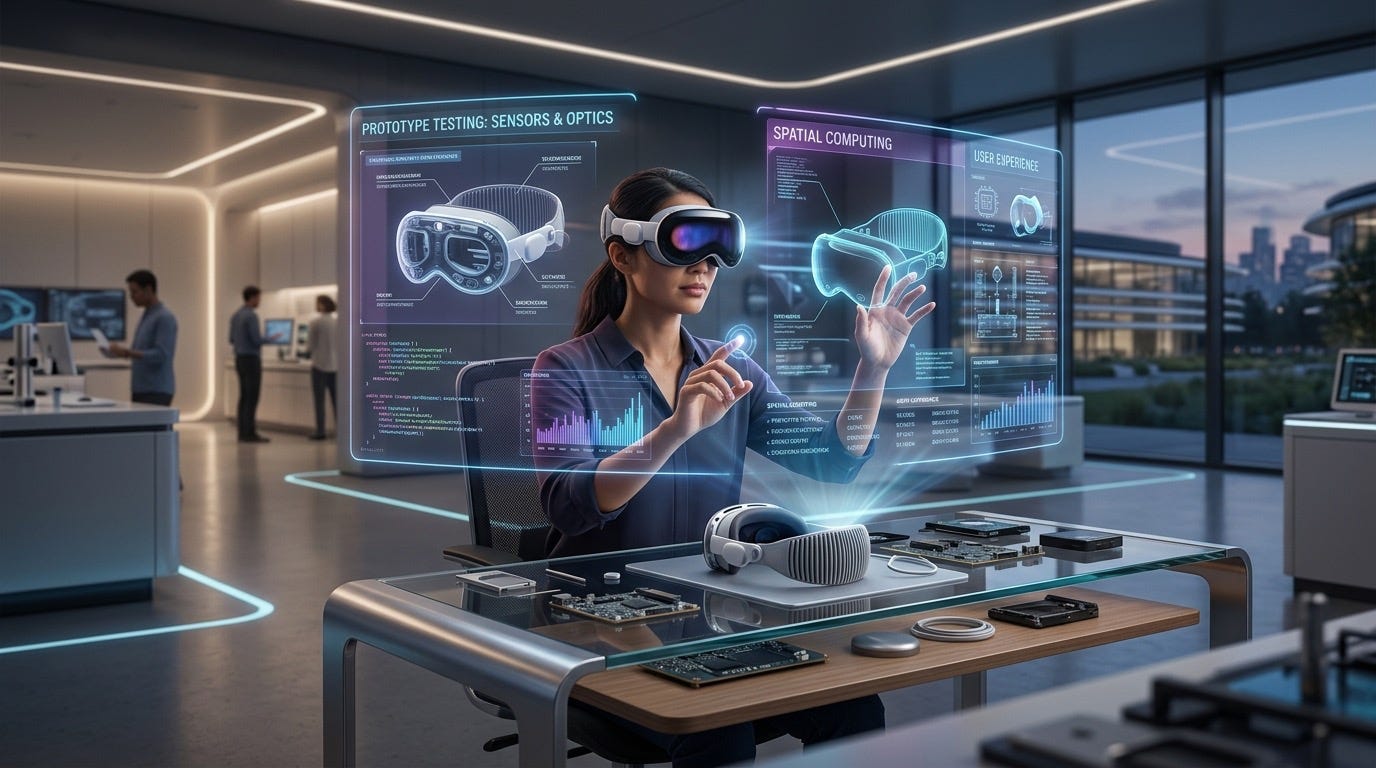
In June 2023, Apple did something it had not done in nearly a decade: it unveiled an entirely new computing platform.
Tim Cook stood onstage and declared that Apple Vision Pro would usher in “the era of spatial computing.” Apple called it the company’s most advanced consumer electronics device ever created. The demonstration was appropriately Apple-esque: enormous floating screens, FaceTime calls suspended in your living room, 3D photographs, movies projected at cinema scale, and a user interface controlled with nothing more exotic than your eyes and fingers. Read Apple’s original Vision Pro launch announcement (Apple)
For a few minutes, it looked as if Minority Report had been acquired by Cupertino.
Then Apple revealed the price: $3,499.
And somewhere, several million people quietly decided that perhaps regular old reality wasn’t so terrible after all.
Three years later, the evidence is increasingly difficult to spin. Vision Pro has not become the next iPhone, iPad, Apple Watch or even AirPods. IDC data cited by the Financial Times indicates Apple shipped roughly 390,000 Vision Pro units in 2024. Production was reportedly halted in early 2025 after inventory accumulated, U.S. and U.K. digital advertising spending for the product fell more than 95% during 2025, and IDC expected only about 45,000 units to ship during the crucial fourth quarter of that year. Read the Financial Times investigation into Vision Pro’s weak sales (Financial Times)
And on August 21, 2026, the story became harder still to dismiss. Apple cut roughly 100 positions from its Vision Pro organization, largely shut down a team focused on gaming, and reduced the group producing its expensive Apple Immersive Video content. The company says Vision Pro and visionOS are continuing, but resources are increasingly moving toward AI and lighter smart-glasses-style devices. Read Bloomberg’s reporting on Apple’s August 2026 Vision Pro cuts (Yahoo Finance)
So yes: if Vision Pro was supposed to become Apple’s next mass-market computing platform, the first generation failed.
But “it cost too much” is an unsatisfying explanation.
Apple’s bigger mistake was more interesting.
It built perhaps the finest headset anybody had ever made at precisely the moment the market was beginning to discover that people didn’t really want headsets.
First, let’s define what “failed” means
There is a danger in judging every new Apple product against the iPhone.
The original iPhone sold its millionth unit just 74 days after launch. Apple was so pleased that Steve Jobs publicly bragged about the milestone. Apple’s announcement of its millionth iPhone sale (Apple)
Vision Pro never had a realistic chance of matching that trajectory.
Cook eventually acknowledged as much:
“At $3,500, it’s not a mass-market product.”
He described Vision Pro instead as an “early-adopter product” for customers who wanted tomorrow’s technology today. (MacRumors)
That’s fair.
In fact, Apple’s original production expectations had already been dramatically reduced before launch. The Financial Times reported in 2023 that Apple initially hoped to sell around one million units during Vision Pro’s first year but reduced production expectations to fewer than 400,000 because manufacturing the micro-OLED displays and other components was extraordinarily difficult. Read the FT’s pre-launch report on Vision Pro manufacturing difficulties(Financial Times)
So 390,000 shipments in 2024 were not catastrophic relative to Apple’s already-constrained supply.
The real problem came afterward.
Successful platform products normally produce a flywheel:
users → developers → better apps → more users → more developers.
Vision Pro produced something closer to a ceiling fan with one blade missing.
Initial curiosity was enormous. Long-term momentum was not.
That is where the failure becomes strategically interesting.
1. Apple confused technological breakthrough with customer value
Vision Pro contains some astonishing engineering.
The displays are superb. Eye tracking feels almost telepathic. You look at something and pinch your fingers together. It responds.
No controllers.
No mouse.
No instructions involving “press trigger B while holding grip button A.”
Reviewers who were skeptical of the concept routinely praised the interface. Ars Technica, after attempting to work almost entirely inside Vision Pro for a week, described the eye-tracking and finger-gesture system as brilliantly conceived and said the device genuinely demonstrated compelling possibilities for spatial computing. Read Ars Technica’s week-long Vision Pro productivity test (Ars Technica)
That’s precisely why Vision Pro makes such a useful product-management case study.
A product can be technologically extraordinary and commercially unnecessary.
Apple showed consumers dozens of things Vision Pro could do:
replace multiple monitors;
watch giant movies;
view spatial photos;
conduct FaceTime meetings;
play games;
meditate;
manipulate 3D models;
work on airplanes;
explore immersive environments.
What it struggled to answer was much simpler:
What problem in my life is painful enough that I will pay $3,499 and strap nearly a kilogram of electronics to my head to solve it?
That question never received an obvious answer.
The iPhone did.
It replaced or improved devices people already carried every day: phone, iPod, camera, browser, email device, eventually GPS and much more.
Vision Pro often replaced something customers already liked.
Want to watch Netflix? You probably own a television.
Want three monitors? Monitors are inexpensive.
Want to write email? Your MacBook does not require facial cushioning.
Want to attend a Zoom meeting? Your coworkers may prefer that your face look like your actual face.
Vision Pro therefore suffered from a deadly innovation problem: spectacular demos without sufficiently frequent jobs-to-be-done.
The demo made people say, “Wow.”
The product needed to make them say, “I need this every Tuesday.”
Those are very different sentences.
2. The physical form factor fought against the product’s own ambitions
Apple marketed Vision Pro as a general-purpose “spatial computer.”
General-purpose computers are used for hours.
Unfortunately, human faces have opinions about that.
The original Vision Pro weighed roughly 600–650 grams depending on configuration, excluding its separate 353-gram battery. See Apple’s Vision Pro technical specifications (Apple Support)
That’s a lot of hardware sitting on your cheekbones and forehead.
The newest M5 version improved the headband and counterbalancing, but the current configuration is still substantial: Apple lists the device at roughly 750–800 grams including the Light Seal and Dual Knit Band, plus the separate battery. Battery life reaches around 2.5 hours of general use and three hours of video. See Apple’s current M5 Vision Pro specifications (Apple Support)
None of this is disastrous for a 30-minute experience.
It becomes extremely important if Apple’s ambition is to replace your laptop monitor for eight hours.
One Guardian reviewer reported that after a month of daily use he could manage approximately two-hour sessions, but still experienced neck, shoulder and back discomfort after extended wear. (The Guardian)
This exposes a fundamental product contradiction.
Vision Pro’s hardware was optimized for fidelity.
Its use cases required comfort.
Apple chose displays, sensors, glass, aluminum, cameras, compute power and visual quality because it wanted the experience to feel magical.
Every one of those decisions carried weight, power and cost.
The engineering team succeeded.
The human neck lost.
3. $3,499 wasn’t merely expensive. It destroyed the ecosystem economics.
Price does matter, just not in the simplistic “people don’t like expensive things” sense.
Apple sells plenty of expensive things.
A well-equipped MacBook Pro can cost thousands of dollars. People buy it because they can calculate its value.
Vision Pro’s price created a more subtle platform problem.
Few users meant limited developer revenue.
Limited developer revenue meant fewer ambitious native applications.
Fewer applications meant fewer reasons for consumers to buy Vision Pro.
Congratulations: you have invented the world’s most expensive chicken-and-egg problem.
Apple tried to jump-start the ecosystem cleverly. At launch, more than one million iPad and iPhone applications could technically run on Vision Pro, while more than 600 experiences had been designed specifically for the device. Apple’s launch-day Vision Pro app announcement (Apple)
By June 2024, Apple said the number of native spatial apps had exceeded 2,000.
That sounds impressive until you examine the trajectory.
By October 2025 — more than a year later — Apple reported only “more than 3,000” apps built for visionOS. Apple’s October 2025 update on the Vision Pro app ecosystem (Apple)
So the ecosystem grew rapidly during the launch excitement and then dramatically more slowly.
Independent Appfigures data spotted the warning almost immediately. After an early surge of Vision-specific releases, new launches fell sharply following the headset’s debut, at one point reaching just one new Vision-only application during the final week of March 2024. See Appfigures’ analysis of slowing Vision Pro development (Appfigures)
Developers are rational.
Suppose you run a 20-person SaaS company.
Should you spend six months creating an extraordinary spatial application for perhaps hundreds of thousands of users?
Or improve your iPhone app for hundreds of millions?
The spreadsheet is not particularly conflicted about this.
4. Apple launched a platform before it had a killer app
There is a subtle but important distinction between having apps and having a killer app.
Vision Pro had Disney+. Microsoft 365. Zoom. Slack. Safari. Apple TV. Games. Productivity utilities.
What it lacked was the application that made people forgive everything else.
Nintendo had Mario.
The iPod had 1,000 songs in your pocket.
BlackBerry had mobile email.
Instagram helped sell smartphone cameras.
ChatGPT gave generative AI its consumer “aha!” moment.
Vision Pro had… extremely large Safari windows.
They are beautiful Safari windows, granted.
Apple Immersive Video came closest to providing something genuinely impossible on conventional devices. Apple’s 180-degree, stereoscopic, high-resolution films can create an extraordinary sense of presence.
But immersive video faced the same economic trap as native apps.
It is expensive to create.
The audience was tiny.
And Apple is now reducing the team producing it. Bloomberg reported in August 2026 that individual immersive productions could cost millions of dollars while the limited number of active Vision Pro users made that expenditure increasingly difficult to justify. (MacRumors)
This is particularly revealing.
When your killer content is too expensive to produce because too few people own the hardware, while too few people buy the hardware because there isn’t enough killer content, your flywheel is rotating in the wrong direction.
5. Vision Pro was surprisingly antisocial
Apple understood one uncomfortable fact about VR headsets: humans tend to dislike talking to somebody whose face has been replaced by ski goggles.
Its solution was EyeSight.
The front of Vision Pro displays a representation of the wearer’s eyes, supposedly allowing people nearby to maintain a sense of connection.
It was an admirable attempt.
It was also a sign that Apple was solving a problem created by the product itself.
Then came Personas — digital representations of Vision Pro owners used during calls.
Early versions landed somewhere between Pixar and a witness-protection reconstruction.
Ars Technica’s week-long productivity experiment concluded that Vision Pro’s weakest professional use case was meetings, describing the Personas issue rather memorably as “social suicide.” (Ars Technica)
This matters because computing is becoming more collaborative.
Slack, Teams, Zoom, Meet, multiplayer games, social video and hybrid work all depend on effortless interaction with other people.
Vision Pro often inserted hardware between you and them.
Apple’s marketing repeatedly emphasized that Vision Pro allowed users to remain present in their surroundings.
But presence isn’t merely seeing the person beside you.
It is also them being able to see you.
6. Apple underestimated how badly gaming mattered
Apple was careful not to call Vision Pro a VR headset.
It was a “spatial computer.”
This was understandable branding. VR had accumulated years of baggage: gamers, motion sickness, Meta’s metaverse spending spree and assorted virtual meeting rooms populated by torsos without legs.
But refusing the category doesn’t eliminate its strongest existing customer segment.
Gaming had been one of the few proven reasons consumers were willing to wear a headset.
Meta understood that.
Apple entered with gorgeous displays, excellent spatial tracking and tremendous processing power — and without standard VR motion controllers.
Instead, it prioritized eye and hand tracking.
Elegant? Absolutely.
Ideal for manipulating menus? Yes.
Ideal for swinging a sword, firing a virtual bow or handling fast physical interaction?
Not always.
The platform eventually added richer controller support, and the M5 release supported accessories including PlayStation VR2 Sense controllers. (Apple)
But ecosystems have path dependence.
Gamers were already on Quest, PlayStation VR and PC VR platforms. Developers were already there with them.
Apple needed either to embrace gaming aggressively enough to migrate that audience or produce a new use case dramatically larger than gaming.
It did neither.
The August 2026 decision to largely shut down Vision Pro’s dedicated gaming team feels less like the cause of the problem than the final admission that the strategy never achieved escape velocity. (The Verge)
7. The competitor that mattered wasn’t Quest. It was Ray-Ban.
This is where the story becomes genuinely interesting.
Apple appeared to believe the evolution of spatial computing would look roughly like:
VR headset → exceptional mixed-reality headset → smaller mixed-reality headset → AR glasses.
Meta accidentally discovered a different path:
ordinary glasses → camera + speakers → AI assistant → display → richer AR.
The distinction is enormous.
Vision Pro asks you to adopt a new behaviour.
Ray-Ban Meta glasses piggyback on one humanity has been practicing for centuries: putting on glasses.
EssilorLuxottica said more than two million Ray-Ban Meta glasses had been sold by early 2025 and announced plans to expand production capacity to 10 million units annually by the end of 2026. Read Reuters on Ray-Ban Meta sales and production expansion (Reuters)
Sales accelerated further. EssilorLuxottica subsequently reported Ray-Ban Meta sales growing more than 200% during the first half of 2025. (EssilorLuxottica)
By 2026, the broader market had moved decisively in the same direction.
IDC reports that display-less smart-glasses shipments increased 167% year over year in Q1 2026, reaching roughly 2.25 million units in a single quarter. Meta held about 69.2% of the category. IDC now expects 13.6 million display-less smart glasses to ship in 2026. See IDC’s 2026 smart-glasses market data (IDC)
Traditional VR and mixed-reality headsets, meanwhile, continued struggling.
IDC’s broader 2025 analysis put it nicely: XR was moving away from bulky headsets and toward devices that consumers might actually wear to the grocery store. Read IDC’s 2025 XR market analysis (IDC)
There is the brutal strategic insight.
Apple may have perfected the wrong intermediate form factor.
8. Apple’s premium strategy worked against platform strategy
Apple usually loves premium positioning.
It enters a category, makes something beautifully integrated, charges more and harvests attractive margins.
That works when the value of the product mostly comes from Apple itself.
Spatial computing is different.
Its value depends heavily on network effects.
You need developers.
Content producers.
Games.
Media companies.
Enterprise software.
Peripheral makers.
Users.
Creators.
Maybe social interactions.
Maybe shared spatial experiences.
Platform businesses often benefit from subsidizing early adoption because every additional customer makes the ecosystem more attractive to developers.
Meta understood this to an almost comical degree, spending tens of billions of dollars through Reality Labs.
Apple instead launched its new ecosystem with a $3,499 velvet rope.
In 2026, even after U.S. Quest prices increased because of component costs, the entry-level Meta Quest 3S costs around $349.99 — roughly one-tenth Vision Pro’s price. See Reuters on current Meta Quest pricing (Reuters)
Of course the products aren’t technically equivalent.
That’s not the point.
Developers care about installed bases.
A magnificent $3,499 platform with hundreds of thousands of customers can be less commercially attractive than an imperfect $350 platform with millions.
Apple optimized gross-margin logic before it had established ecosystem liquidity.
For a platform launch, that may have been backwards.
9. Yet Vision Pro found one place where $3,499 isn’t particularly expensive: enterprise
This is why declaring Vision Pro completely dead would be premature.
In enterprise environments, $3,499 can be pocket change.
An aircraft engine costs considerably more than an Apple headset.
So does shutting down an aircraft for training.
Apple has highlighted Vision Pro applications at companies including KLM, Porsche, SAP and Lowe’s. KLM developed an Engine Shop application allowing technicians to train against detailed 3D engine models rather than requiring equivalent access to physical equipment. Explore Apple’s Vision Pro enterprise case studies (Apple)
Those applications make much more economic sense.
Consider a manufacturer where an error costs $50,000.
A $3,499 headset is no longer expensive.
It is a rounding error.
Training, design visualization, healthcare, engineering, remote assistance, architecture and high-end simulation may therefore represent Vision Pro’s strongest near-term market.
The irony is wonderful.
Apple built what it called a consumer spatial computer and accidentally produced something resembling a workstation.
That isn’t necessarily a bad business.
It just isn’t the next iPhone.
10. The M5 Vision Pro shows Apple could improve almost everything except the fundamental problem
Apple refreshed Vision Pro in October 2025 with its M5 chip.
Performance improved.
Display rendering improved.
Battery life improved.
The Dual Knit Band improved comfort.
Apple Intelligence arrived.
The ecosystem surpassed 3,000 visionOS-native apps. Read Apple’s M5 Vision Pro announcement (Apple)
What did not change?
The starting price remained $3,499.
The physical form factor remained a headset.
And the central value proposition remained difficult to explain without a 30-minute Apple Store demonstration.
This is an important product lesson.
When adoption disappoints, product teams often respond by making the product better.
Faster.
Sharper.
More features.
Better battery.
Better AI.
More comfortable straps.
Sometimes the problem isn’t that the product isn’t good enough.
Sometimes the product is solving the wrong layer of the problem.
Vision Pro did not primarily need a faster processor.
It needed to become something people wanted to wear.
So did Vision Pro really fail?
As of August 2026, I would give three different answers.
As a mass-market consumer product: yes.
Hundreds of thousands of annual units are tiny by Apple standards. Production and marketing were reduced. Developer momentum never developed into an iPhone-style flywheel. Dedicated Vision Pro staffing is being reduced. The price and ergonomics remain formidable barriers. (Financial Times)
As a platform experiment: not necessarily.
Apple now has years of real-world experience with eye tracking, hand tracking, passthrough video, spatial interfaces, 3D content, Personas, spatial photography, developer APIs and human-computer interaction.
That technology does not disappear because Vision Pro itself remains niche.
Apple is still developing visionOS 27 in 2026, including deeper AI and visual-intelligence capabilities. See Apple’s visionOS 27 roadmap (Apple)
As preparation for glasses: Vision Pro may eventually look brilliant.
Imagine an Apple product five years from now that weighs roughly as much as ordinary eyewear.
It recognizes what you are looking at.
Siri understands your environment.
Notifications appear subtly in your field of vision.
Directions float ahead of you.
AirPods provide audio.
Your iPhone supplies compute.
Your Apple Watch provides identity and health context.
And fifteen years of Vision-team engineering quietly sit underneath the whole thing.
Suddenly Vision Pro looks less like Apple’s Newton and more like a $3,499 public prototype.
An extremely polished public prototype, admittedly.
The real product lesson: don’t confuse “magic” with product-market fit
Vision Pro demonstrates one of the most dangerous traps in product development.
Teams can fall in love with capability.
A prototype does something that was previously impossible.
Executives try it.
Their eyes widen.
People start saying things like “paradigm shift.”
PowerPoint decks mysteriously acquire pictures of rocket ships.
Then somebody forgets to ask whether the customer wants to do the thing frequently enough to build a business around it.
Vision Pro had extraordinary experience-market fit.
People tried it and said “wow.”
What it lacked was habit-market fit.
People didn’t reliably wake up the next morning thinking, Where is my Vision Pro?
That distinction should terrify product managers.
A compelling demo measures emotional intensity.
A successful product measures repeated behaviour.
The two correlate less than Silicon Valley would like to admit.
Five lessons product leaders should steal from Vision Pro
First, start with frequency, not novelty. A mediocre solution to something customers do 20 times per day can create more value than a breathtaking solution to something they do twice per month.
Second, hardware friction multiplies behavioural friction. Every extra step — charging, fitting, wearing, adjusting, carrying — must be overcome by proportionally greater value. “Put something on your face” is not equivalent to “open an app.”
Third, platform pricing is ecosystem strategy. If developers need millions of users before investing, maximizing first-generation hardware margins may minimize long-term platform value.
Fourth, killer apps cannot be replaced with feature inventories. Customers don’t buy platforms because PowerPoint slides contain 37 possible use cases. They buy because one use case becomes indispensable.
And fifth, form factor is strategy. Apple spent enormous engineering effort making a headset extraordinary. Meta discovered that being slightly useful in normal-looking glasses could produce better adoption than being astonishing inside a computer strapped to your face.
That’s uncomfortable.
It is also probably the most important lesson of the entire Vision Pro story.
Apple may have lost the headset battle and still win spatial computing
There is a lovely historical precedent here.
Apple did not invent the MP3 player.
It did not invent the smartphone.
It did not invent the tablet.
It did not invent the smartwatch.
Its traditional strength has been recognizing when technology is finally ready to cross the gap between possible and normal.
Vision Pro reversed the formula.
Apple crossed “possible” spectacularly.
It never reached “normal.”
The industry now appears to be converging on the missing piece: glasses.
And that’s why Vision Pro’s failure may ultimately prove useful rather than embarrassing.
Apple has learned what millions of dollars of laboratory testing could never teach it:
People love spatial computing.
They love enormous virtual displays.
They love immersive memories.
They love interfaces controlled by eyes and hands.
They just don’t particularly love wearing a 600-plus-gram computer to get them.
Perhaps the future really is spatial.
Perhaps Tim Cook was right about that part.
But the first rule of building the computer of the future turns out to be surprisingly old-fashioned:
Make sure people actually want to put it on.