

How a cartoon owl, streaks, and relentless experimentation turned language study into a daily habit
“You can’t teach somebody who isn’t there.” - Luis von Ahn, CEO of Duolingo. (The Verge)
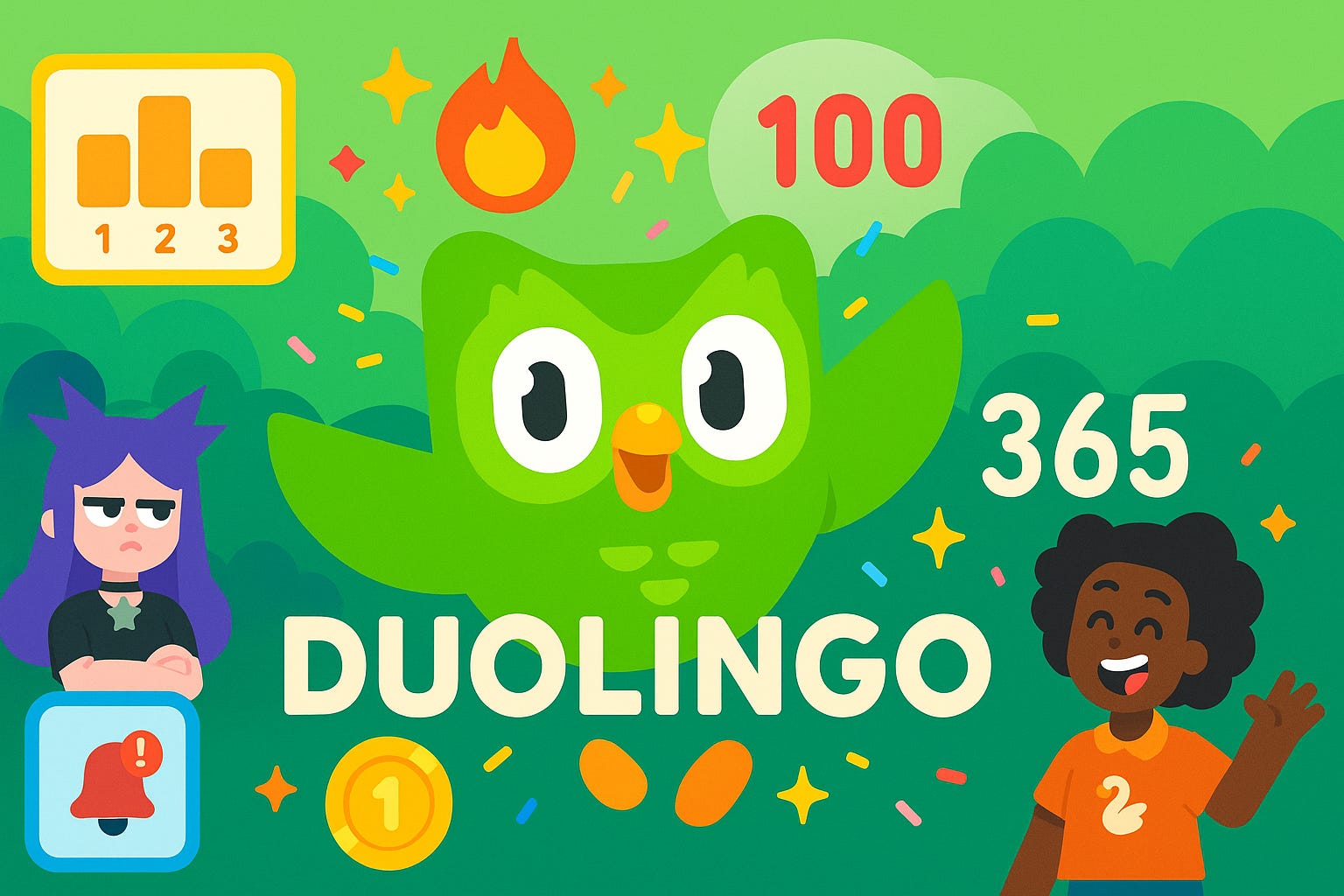
The story in one line
Duolingo took an activity most of us feel we should do (study a language) and made it something we want to do-today, tomorrow, and the day after. That shift-from obligation to habit-helped Duolingo become the world’s most downloaded education app and a public company with tens of millions of daily learners. (Duolingo Blog)
The scale is real: in 2025 Duolingo reported ~47.7 million daily active users (DAU) and ~10.9 million paid subscribers, after years of product‑led growth. (Investopedia)
This case study breaks down the product systems behind the results-focusing on (1) habit formation mechanics, (2) an experimentation culture that tests everything, and (3) onboarding that gets you to magic fast.
PM Lesson 1: Habit formation by design
Duolingo’s habit strategy centers on a single behavior: complete one short lesson every day. Everything else-characters, sounds, leagues, widgets, notifications-pushes you toward opening the app and finishing today’s rep.
Streaks (and why they’re “sticky but humane”)
The streak timer counts consecutive days of practice and displays your flame front‑and‑center. That’s classic loss aversion: the longer your streak, the more it hurts to lose it. But Duolingo moderates that pressure with guardrails:
Streak Freeze: A pre‑equipped “insurance” you can buy with in‑app currency (or get via perks) so one missed day doesn’t break your chain. Duolingo’s own help content calls it insurance for missed days. (Duolingo)
Streak Society: Milestone recognition and perks for sustained consistency, elevating streaks from a private counter to an identity signal. (Duolingo Blog)
Why it works: streaks turn long‑term goals (“become fluent”) into a daily yes/no decision. Learners get a quick hit of progress and a reason to come back tomorrow-precisely the behavior von Ahn optimizes for: show up. (The Verge)
Leaderboards and leagues (competition as fuel)
Every week, learners are placed into a league-a 7‑day XP competition with progression through 10 tiers up to Diamond. Importantly, Duolingo tested leaderboards in 2018 and expanded them after seeing traction: “a little competition worked for a lot of learners.” There’s even a Diamond Tournament for the most engaged users. And if competition stresses you out, you can opt out. (Duolingo Blog)
What matters for PMs is that leaderboards give you a social reason to return (“I’m close to promotion”) that compounds the individual reason (keep the streak). This dual motivation-intrinsic and peer‑driven-tilts the daily choice toward one more lesson.
Notifications (AI + A/B tested nudges)
Duolingo doesn’t just send reminders; it learns which reminders work for whom. The team built a contextual bandit system trained on ~200 million practice reminders to pick the best daily nudge, spacing out repeats to avoid fatigue. The result: “within weeks” more people completed lessons and “tens of thousands of new learners” returned. (Duolingo Blog)
That system sits inside an experimentation culture (“Test everything.”) so even templates, timing, and tone are continually optimized instead of chosen by taste. (Duolingo Blog)
Characters, sounds, and animations (micro‑rewards that matter)
Duolingo’s cast-Lily, Zari, Bea, and more-was created expressly to “motivate our learners-and for them to love back.” The brand guidelines lean into Duo being expressive and “quirky,” giving product teams a toolkit for encouragement that feels alive. (Duolingo Blog)
Micro‑interactions amplify progress: a cheery “ding,” celebratory fireworks, and Duo’s wave reinforce correct answers and lesson completion. Duolingo has even used these moments to reduce perceived latency-showing the “Session Complete!” celebration immediately while finishing background work-yielding a 60%+ reduction in perceived wait and a DAU lift. That’s habit design meeting performance engineering. (Duolingo Blog)
Aligning engagement with learning
To keep “fun” from drifting away from “learning,” Duolingo introduced Time Spent Learning Well (TSLW)-a proprietary metric the company uses to ensure experiments improve quality learning time, not just clicks. (Duolingo Blog)
Takeaway: Pick one core habit, build multiple motivational “routes” to it (loss aversion, competition, celebration), and add humane escape hatches (freezes, opt‑outs) to avoid burnout.
PM Lesson 2: An A/B‑testing culture that really tests everything
Duolingo doesn’t ship updates because they’re beautiful; they ship because experiments say they work. The company is explicit: > “Test everything.” (Duolingo Blog)
A few instructive examples:
Six lines of code → +6% DAU. Adding a small red dot to the app icon (“something unresolved”) bumped DAU by ~6%; a v2 added another +1.6%. The lesson: cheap tests can have outsized impact. (First Round)
In‑lesson coach → +7.2% D14. Growth‑mindset encouragement from Duo (“your hard work is paying off”) beat generic praise and increased day‑14 return rate by 7.2%. The lesson: copy is a product surface. (First Round)
Leaderboards → more starts and completions. Internal experiment reports show leagues increased both session starts and finishes-wins for engagement and learning-before the feature rolled out broadly. (Duolingo Blog)
Scale matters here. Duolingo has “hundreds” of experiments running simultaneously; in 2024 alone the Android performance team ran 200+ A/B tests, attributing “hundreds of thousands” of DAU gains to the improvements. Experiments are rolled out gradually, monitored daily, and shut down if they harm retention or learning. (Duolingo Blog)
Gina Gotthilf (former VP Growth) summarized the mindset succinctly: > “We A/B test nearly everything and let the metrics make the vast majority of decisions.” She also cautions to limit arms (control + two variants) to avoid muddy analysis. (First Round)
Finally, Duolingo ties its experimentation program to a growth model that decomposes DAU into movable sub‑metrics (e.g., Current User Retention Rate). Focusing teams on the most “causally promising” levers helped 4x DAUs since 2019-another example of data informing where to test, not just what to test. (Duolingo Blog)
Takeaway: Run lots of cheap, clean experiments, but choose them with a model of the system you’re trying to move. Let results decide-and preserve a few non‑negotiables (e.g., mission, brand) you won’t cross even if a test “wins.” (First Round)
PM Lesson 3: Onboarding that gets you to the “magic moment” in minutes
Great onboarding does two jobs: show value fast and earn the right to ask for commitment. Duolingo’s funnel does both.
1) Goal & motivation first. New learners set a daily goal and share why they’re learning (“travel,” “school,” “work”). That primes commitment and enables tailored content. (GoodUX)
2) Right level, right away. Users self‑segment by experience; confident learners can take a placement test, while beginners jump into basics. Segmentation avoids early boredom or overwhelm. (GoodUX)
3) Experience the product before registration. Duolingo practices gradual engagement: it lets you do a short translation exercise and feel progress before asking to sign up. Those prompts appear at logical breakpoints (e.g., after finishing a lesson). (GoodUX)
4) Soft walls beat hard walls. In Duolingo’s own A/B tests, delayed sign‑up (ordering “dominoes” so momentum pushes you to register) performed better than front‑loading account creation. (First Round)
5) Micro‑rewards seal the deal. Clean copy, Duo’s wave, a satisfying “ding,” and visible progress rings create a tight feedback loop that says, “Yes, you can do this.” (GoodUX)
PM framing: Duolingo’s magic moment is “I understand and can answer something in a new language.” The onboarding optimizes time‑to‑first‑success while saving friction (“account creation”) for after you’ve felt value.
What you can steal for your product (playbook)
Define a single daily habit you will relentlessly reinforce. Everything should ladder up to that one behavior. (For Duolingo, one lesson daily.)
Design humane pressure. Use commitment devices (streaks), plus forgiveness (freezes, repairs) so a bad day doesn’t nuke months of progress. (Duolingo)
Layer motivations. Stack intrinsic progress (XP and path) with social drivers (leagues, friend quests) so there’s always another reason to return. (Duolingo Blog)
Make micro‑wins feel great. Invest in sound/animation to reward correctness and completion-and to mask inevitable waits. You’ll improve perceived speed and retention. (Duolingo Blog)
Instrument onboarding for time‑to‑value. Aim for a first “I did it!” within minutes; defer sign‑up until after the learner has tasted success. (GoodUX)
Run experiments at two altitudes. Ship tiny tests (copy, icons) and thematic tests (feature concepts). Keep arms few; let metrics call the shot. (First Round)
Guard your north star with sub‑metrics. Break DAU (or your equivalent) into movable components. Staff teams to own the lever most predictive of the north star. (Duolingo Blog)
Align engagement with outcomes. Define (and monitor) a qualitative metric like TSLW to ensure “fun” equals “learning well,” not just “more taps.” (Duolingo Blog)
Automate the nudges. Use contextual bandits or rules engines to personalize reminders; measure freshness/novelty to avoid habituation. (Duolingo Blog)
Fix performance like a growth lever. Duolingo’s Android performance work shows speed gains can be growth gains-measurably. Treat latency as part of habit‑building. (Duolingo Blog)
The business impact (why this works)
When engagement compounds, so do your economics. Duolingo’s habit‑first, test‑everything approach shows up in the numbers: in 2025, DAU grew ~40% YoY to ~47.7M, paid subscribers rose to ~10.9M, and revenue guidance ticked past $1B on product‑led growth-an arc powered not by ad spend but by features people tell friends about. (Investopedia)
And as von Ahn admits candidly, when trade‑offs emerge, Duolingo prioritizes engagement-because if people don’t show up, nothing else matters. That clarity of strategy makes the product choices legible. (The Verge)
A quick word on trade‑offs
Gamification can drift into empty grinding. Duolingo mitigates this by (a) measuring Time Spent Learning Well, (b) testing features against learning proxies (e.g., session completion), and (c) giving learners control (opt‑outs, humane streak tools). That’s the bar for ethical habit design in education: build engagement that also builds skill. (Duolingo Blog)
Closing
Duolingo didn’t just slap points and badges onto a workbook. It built a habit system and an experimentation machine that together turn “study sometime” into “study today.” If you’re building a product that requires steady practice-fitness, finance, mindfulness, upskilling-there’s a lot to borrow here. Start with the one behavior you need daily, ship humble experiments to reinforce it, and let the data (and your learners) steer the rest.
Or, as Duolingo puts it: “Test everything.” (Duolingo Blog)