

War metaphors are imperfect for modern product work—but Sun Tzu’s 2,500‑year‑old strategy principles map surprisingly well to how we research markets, mobilize teams, and ship value. Below, I translate key lines from The Art of War into concrete product management moves, and I back them up with research where possible.
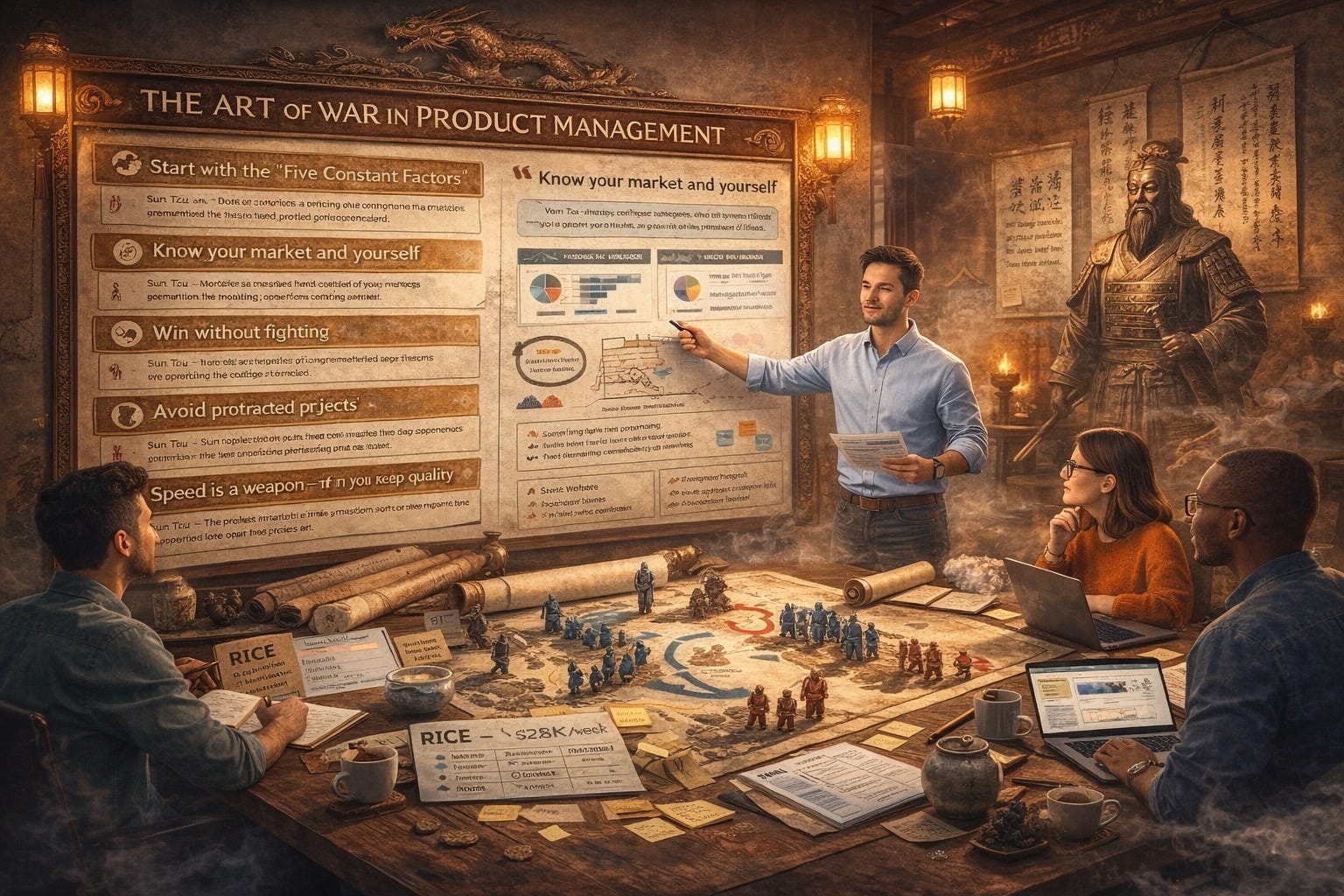
1) Start with the “five constant factors”
“The art of war…is governed by five constant factors… (1) Moral Law; (2) Heaven; (3) Earth; (4) The Commander; (5) Method and discipline.” (Internet Classics Archive)
Product translation.
Before you commit to a roadmap, assess your environment along five analogous dimensions:
Moral law → Mission/strategy fit. Do we have a shared, credible product strategy customers and executives can rally around?
Heaven → Timing. Seasonality, regulatory windows, technology waves—are we launching at a favorable moment?
Earth → Terrain. Platform constraints, app store policies, partner ecosystems, distribution channels.
Commander → Leadership. Do product, design, and engineering leaders exhibit clarity and courage, and make decisions quickly?
Method/discipline → Process & economics. Do we have the operating model (cadence, budgeting, release process, analytics) to sustain momentum?
Treat this as your pre‑mortem checklist. It’s a fast way to surface hidden dependencies before you promise dates. (Marxists Internet Archive)
2) Know your market and yourself—or be surprised later
“If you know the enemy and know yourself, you need not fear the result of a hundred battles.” (gutenberg.org)
Product translation.
Run two loops continuously:
Know the market: competitor teardowns, win/loss interviews, pricing scans, and usage telemetry.
Know yourself: are you actually at or near product/market fit?
A simple, research‑backed test is the Sean Ellis PMF survey. Across ~100 startups, teams with strong traction consistently had ≥40% of users who would be “very disappointed” if the product went away; those who struggled were typically <40%. This gives you a crisp, comparable signal to prioritize retention and fit before chasing scale. (First Round)
Practice: instrument the PMF survey for your active users quarterly; pair it with cohort retention and a short “top three reasons why” prompt.
3) Win without fighting: design for uncontested space
“Supreme excellence consists in breaking the enemy’s resistance without fighting.” (Internet Sacred Text Archive)
Product translation.
Competing feature‑for‑feature is trench warfare. Applying Blue Ocean Strategy means reframing the basis of competition and creating fresh demand (e.g., Cirque du Soleil’s hybrid of theatre and circus). Summaries of the research note that a minority of “new market” moves generated a disproportionate share of revenues and profits in studied portfolios—evidence that reframing the game can beat incrementalism. (moodle.najah.edu)
Practice: build a simple strategy canvas around the key factors customers weigh today, then deliberately change the curve—eliminate/raise/reduce/create.
4) Know when not to build
“He will win who knows when to fight and when not to fight.” (gutenberg.org)
Product translation.
Saying “no” is a strategic act. Use RICE scoring (Reach × Impact × Confidence ÷ Effort) to force clear trade‑offs and explain them to stakeholders. RICE originated at Intercom and is now widely used to neutralize bias in prioritization debates. (Intercom)
Complement RICE with Cost of Delay (CoD): if you quantify only one thing, quantify how much money (or mission impact) you lose each week you don’t ship a given capability. CoD reframes prioritization from opinion to economics. (Project Management Institute)
5) Avoid protracted projects
“There is no instance of a nation benefiting from prolonged warfare.” (en.wikiquote.org)
Product translation.
Long, monolithic projects destroy optionality and raise risk. The Project Management Institute reports that organizations still waste a measurable share of investment due to poor project performance—~11.4% in 2020, improving to ~9.4% in 2021. Time‑boxing and incremental delivery help you escape this gravity well. (Project Management Institute)
Practice: plan in 6–8 week “bets” with explicit kill or continue criteria. Decompose epics until each slice changes a KPI, not just code.
6) Speed is a weapon—if you keep quality
“Rapidity is the essence of war.” (gutenberg.org)
Product translation.
Fast feedback loops—not heroics—let you learn and adapt. The DORA/Accelerate research program provides an evidence‑based way to measure software delivery: deployment frequency, lead time for changes, change failure rate, and time to restore service. High performers on these “Four Keys” correlate with better organizational outcomes across industries. (Dora)
Practice: baseline your Four Keys, set targets, and invest in CI/CD to raise deployment frequency while lowering failure rates (the research shows speed and stability can improve together). (Google Services)
7) Use “deception” ethically: experiment in the open, launch in the dark
“All warfare is based on deception.” (University of Alberta)
Product translation.
In product, “deception” isn’t about misleading customers; it’s about controlling blast radius. Ship behind feature flagsand do progressive delivery so customers only encounter changes when they’re ready—and you can turn things off instantly. Martin Fowler’s seminal write‑up explains the technique and its trade‑offs; modern trunk‑based workflows reduce merge pain and risk. (martinfowler.com)
Practice: default to short‑lived release toggles; require a removal plan for every flag to prevent “flag debt.”
8) Concentrate force where it matters: reallocate aggressively
Sun Tzu emphasizes massing strength at decisive points and avoiding the enemy’s strongholds. In corporate terms: don’t starve your best opportunities.
Independent research shows dynamic resource reallocation—shifting capital, talent, and attention to high‑return areas—correlates with superior shareholder returns and resilience. If you allocate in straight lines year after year, value suffers. (McKinsey & Company)
Practice: at least quarterly, move people and budget toward the top two opportunities on your strategy canvas—even if it means pruning pet projects.
9) Keep supply lines short: instrument discovery and delivery
“By method and discipline are to be understood…the maintenance of roads by which supplies may reach the army.” (Marxists Internet Archive)
Product translation.
Your “roads” are customer insight and deployment pipelines. Teresa Torres defines continuous discovery as weekly touchpoints with customers by the team that’s building the product. Pair that with rapid prototyping and small‑batch delivery to sustain flow from insight to impact. (Product Talk)
When you need quick usability signals, don’t over‑engineer research: the Nielsen Norman Group has long shown that small qualitative tests (≈5–9 users) uncover most usability issues for a specific flow—cheaply and fast. (Nielsen Norman Group)
10) Align morale and mindset
“He will win whose army is animated by the same spirit throughout all its ranks.” (Marxists Internet Archive)
Product translation.
The best practices in the world won’t overcome a fearful culture. Google’s Project Aristotle found that psychological safety—people feeling safe to take interpersonal risks—is the top factor in effective teams. Create space to speak up, surface bad news early, and run blameless postmortems. (Rework)
11) Strike where competitors are weak
Sun Tzu advises attacking the opponent’s plans and weak points rather than their strengths. For products, that means: don’t reflexively chase parity on their best features.
Use Opportunity Solution Trees to reveal better routes to your outcome than a head‑to‑head fight; they help teams compare opportunities and solutions in one visual map and avoid “build the thing” tunnel vision. (Product Talk)
Practice: for each major OKR, map the opportunity space (jobs, pains, desires) and test multiple solution spikes in parallel.
12) Convert speed into learning—safely
Speed without learning is thrash; learning without safety is chaos. The DORA research shows that elite delivery isn’t about recklessness: improving lead time, deployment frequency, reliability, and recovery together predicts better organizational performance. That gives product leaders an empirical argument for investing in engineering excellence as a growth lever, not just a cost center. (Dora)
Practice: track your Four Keys alongside product outcomes (activation, retention, expansion). Tie “engineering bets” to leading indicators (e.g., faster “lead time for changes” → more experiments/month → higher win rate on experiments).
Playbook: a one‑quarter “Art of War” plan for PMs
Week 1: Environmental scan (the five factors).
Create a single slide per factor (mission fit, timing, terrain, leadership, process) listing risks and opportunities. Use this to align execs before revising the roadmap. (Internet Classics Archive)Week 2: Know yourself & the market.
Run the PMF 40% survey with active users; analyze by segment. In parallel, compile a teardown of the top two competitors’ strengths and gaps. (First Round)Week 3: Opportunity Solution Tree + RICE + CoD.
Map the opportunity space for your top outcome, brainstorm solutions, then score with RICE and Cost of Delay to decide what not to do. (Product Talk)Weeks 4–8: Two discovery sprints; ship in the dark.
Prototype & test 2–3 solution spikes (5–9 users each, per flow). Ship the leading candidate behind feature flags to a small cohort; watch leading metrics; iterate weekly. (Nielsen Norman Group)Weeks 9–12: Expand, measure, reallocate.
If the flag cohort clears your guardrails (conversion, retention, CFR/MTTR), begin progressive rollout. Move people and budget toward what’s clearly working; kill one stalled initiative to pay for it. Track your Four Keys to keep speed and stability in balance. (Dora)
Closing thought
Sun Tzu’s lines are compact, but their modern product meaning is clear:
Diagnose the landscape before you move (five factors).
Learn faster than rivals (PMF signals, usability sprints, Four Keys).
Pick your battles (RICE + CoD) and avoid protracted campaigns (time‑box and ship small).
Shape markets rather than chase them (blue oceans).
Build teams that can tell you the truth quickly (psychological safety).
Do these, and you’ll “win” the only battles that matter in product: faster learning, happier customers, and compounding business impact.