

If you build products long enough, you discover a hard truth: most costly rework doesn’t come from buggy code—it comes from unclear intent. PMI’s Pulse of the Profession found that inaccurate requirements gathering was a primary cause of project failure for 37% of organizations surveyed. (Project Management Institute) Separately, McKinsey reported that large IT projects average 45% over budget and deliver 56% less value than predicted—evidence that sloppy upfront definition compounds downstream. (McKinsey & Company)
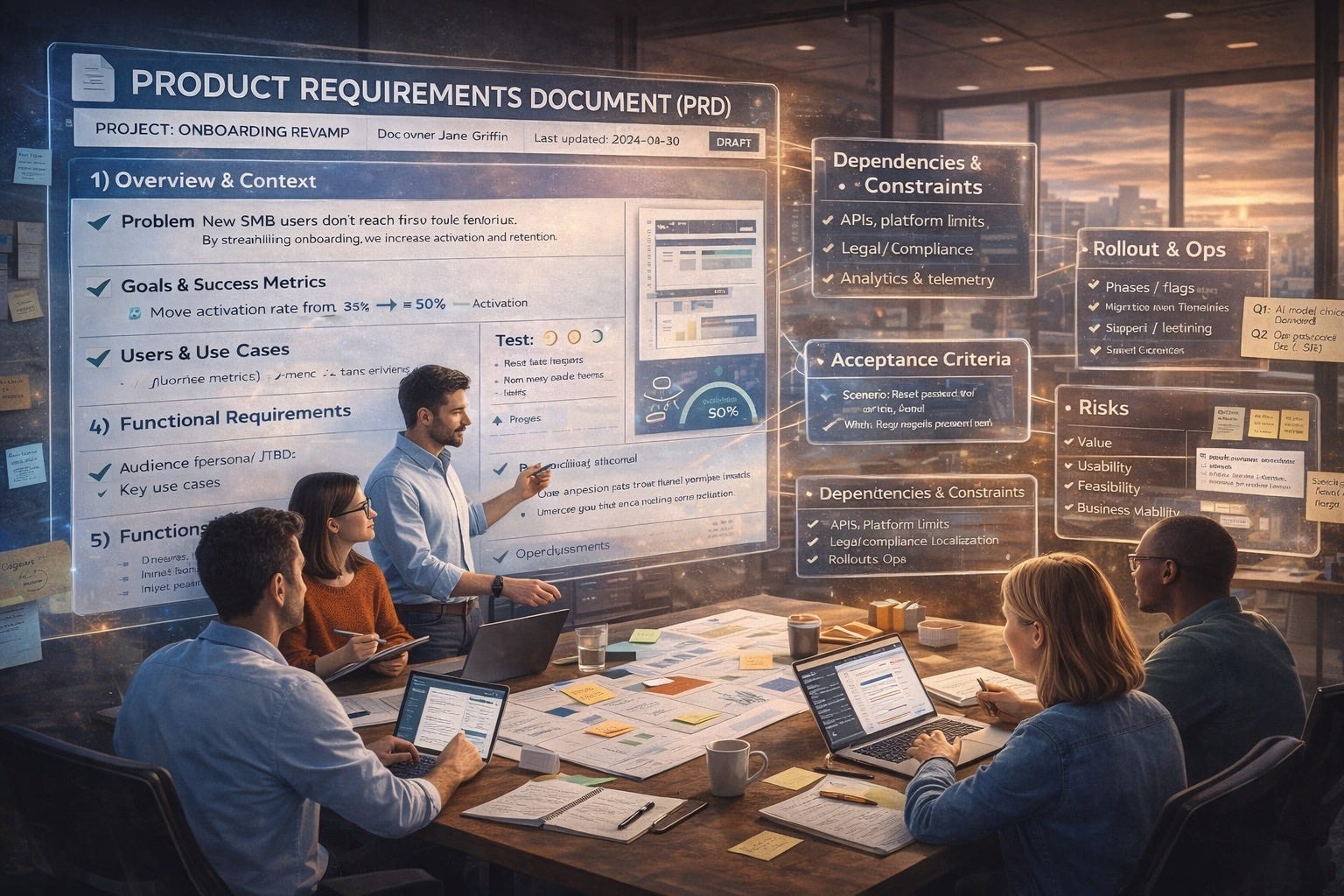
A well‑crafted PRD is a leverage point against those odds. As product veteran Marty Cagan put it, “If the PRD is not done well, it is nearly impossible for a good product to result.” (CIMIT MAIN) But “good” today doesn’t mean a 50‑page tome. It means a crisp, collaborative, testable artifact that enables engineering to ship the right thing with minimal ambiguity.
Below is a practical playbook—best practices, structure, and examples—to help you write PRDs that do exactly that.
First principles: Start with customers and outcomes
Amazon’s first leadership principle states, “Leaders start with the customer and work backwards.” (amazon.jobs) Their Working Backwards process operationalizes this principle with a press release + FAQ (“PR/FAQ”) that forces clarity on value before solution details. You don’t need to adopt the PR/FAQ wholesale to borrow the mindset: your PRD should begin with the user problem and the business outcome, not with interface details or database fields. (Working Backwards)
To make this concrete, open your PRD with:
Problem statement: Who’s struggling? What job-to-be-done isn’t met?
Success metrics: The measurable outcomes that define “done” (activation lift, NPS improvement, support ticket reduction, etc.).
Hypothesis: Why this change will move those metrics.
This framing keeps teams oriented toward outcomes rather than output.
The anatomy of a modern PRD (plus a reusable template)
There’s no single “right” format, but strong PRDs tend to share common sections. Atlassian’s widely used templates emphasize basics (context), objectives and success metrics, and assumptions—good scaffolding for most teams. (Atlassian)
Recommended sections
Overview & context
One paragraph: What we’re doing and why now. Link to discovery notes, research plans, and any PR/FAQ or pitch.
Goals & success metrics
The outcomes you expect and how you’ll measure them (leading and lagging indicators). Tie to company/product goals.
Users & use cases
Audience, personas, or jobs-to-be-done. Include primary scenarios.
Express behaviors as user stories: “As a <user>, I want <goal> so that <benefit>.” The Agile Alliance popularized this simple template to keep requirements human‑centered. (Agile Alliance)
Scope
In scope: The smallest set of capabilities to achieve the goals.
Out of scope / later: Equally important to prevent scope creep and protect timelines.
Functional requirements
Bullet the behaviors the system must support. Favor plain language.
Acceptance criteria (make requirements testable)
Write Given / When / Then scenarios so QA and dev can automate against them. Example:
Scenario: Reset password via email
Given an existing user with a verified email
When they request a password reset
Then they receive a reset link that expires in 15 minutes
This Gherkin style aligns product/QA/dev and reduces interpretation gaps. (cucumber.io)
Non‑functional requirements (NFRs)
Performance, security, reliability, usability, maintainability, etc. ISO/IEC 25010 groups these quality attributes into eight categories—use them as a checklist to avoid “forgotten” requirements. (ISO 25000)
Design & UX
Link to wireframes/prototypes. (As Marty Cagan argues, “the majority of the product spec should be the high‑fidelity prototype.”) (Silicon Valley Product Group)
Analytics & telemetry
What events are tracked, where, and why. Define funnels, properties, and retention of data (plus privacy/compliance notes).
Dependencies & constraints
APIs, platform limits, legal/compliance, localization, releases, training.
Risks & assumptions
Call out the four big risks: value, usability, feasibility, and business viability. State how you’ll mitigate each. (Silicon Valley Product Group)
Rollout & ops
Phasing, guardrails, feature flags, support readiness, migration/backfill plans.
Open questions & decisions
Capture what’s unresolved and record decisions with owners and dates.
Changelog
Keep the doc living and searchable.
Copy‑paste PRD template (Markdown)
# Title: <Feature / Project Name>
**Doc owner:** <name> • **Last updated:** <YYYY-MM-DD> • **Status:** Draft/Review/Final
## 1) Overview & Context
One paragraph on the problem, why now, and links to discovery/PRFAQ/pitch.
## 2) Goals & Success Metrics
- Primary metric(s): <metric, target, time window>
- Secondary metric(s):
- Guardrails (what must not regress):
## 3) Users & Use Cases
- Audience/persona/JTBD:
- Key use cases:
- As a <user>, I want <goal> so that <benefit>.
## 4) Scope
- **In scope:** …
- **Out of scope / later:** …
## 5) Functional Requirements
- FR-1: …
- FR-2: …
## 6) Acceptance Criteria (Gherkin)
- Scenario: …
Given …
When …
Then …
## 7) Non-Functional Requirements (ISO 25010 cues)
- Performance: …
- Reliability/Availability: …
- Security/Privacy: …
- Usability/Accessibility: …
- Maintainability/Portability/Compatibility: …
## 8) Design & UX
- Links to prototypes, UI specs, content strings, empty states.
## 9) Analytics & Telemetry
- Events and properties, dashboards, alert thresholds.
## 10) Dependencies & Constraints
- External systems/APIs, legal/compliance/localization, platform limits.
## 11) Risks & Assumptions
- Value risk: …
- Usability risk: …
- Feasibility risk: …
- Business viability risk: …
- Assumptions: …
## 12) Rollout & Ops
- Phases/flags, migration/backfill, support/SOPs, training.
## 13) Open Questions
- Q1: … (owner, due)
- Q2: …
## 14) Decisions (Rationale)
- D1: … (date, approvers)
## 15) Changelog
- <YYYY-MM-DD>: <what changed> (owner)
Use this template “as‑is” for features, or scale it down to a one‑pager for small improvements.
Make requirements testable (and automation‑friendly)
Ambiguity is your enemy. User stories articulate why; acceptance criteria make the what verifiable. Gherkin’s Given/When/Then syntax forces you to specify context, action, and observable outcome—ideal for both manual and automated tests. (cucumber.io)
A few tips:
Write criteria that a non‑developer can check.
Prefer specific thresholds (“p95 response time < 500 ms”) over adjectives (“fast”).
Cover happy path and edge cases (error states, timeouts, permissions).
Tie each criterion to a test case or automated spec to enable traceability later.
Don’t forget the “ilities” (NFRs)
Many PRDs list functional requirements yet bury (or omit) non‑functional ones. That’s a recipe for rework. Use ISO/IEC 25010’s quality attributes—performance efficiency, reliability, usability, security, compatibility, maintainability, portability, and functional suitability—as a checklist. Even one line per attribute dramatically improves alignment between product, design, and architecture. (ISO 25000)
Examples:
Performance: p95 search latency < 200 ms at 2× current traffic.
Security: all PII encrypted at rest (AES‑256) and in transit (TLS 1.3).
Reliability: 99.9% monthly availability; SLOs with alerts to on‑call.
Accessibility: WCAG 2.2 AA for new UI.
Prioritize what makes the PRD (and what waits)
A PRD should constrain, not collect. Intercom’s RICE framework—Reach × Impact × Confidence ÷ Effort—is a simple way to stack‑rank candidate scope and keep the document focused on what moves the needle. Add the RICE score next to each functional requirement or open question so trade‑offs are visible. (Intercom)
Pair the PRD with prototypes (not paragraphs)
Length is not clarity. Cagan’s guidance is blunt: “the majority of the product spec should be the high‑fidelity prototype.” Screens + flows often resolve questions that pages of prose cannot. Embed links to click‑through prototypes and annotate the tricky interactions; then keep the body text short and decisive. (Silicon Valley Product Group)
Tooling and templates you can borrow
Atlassian: battle‑tested Confluence PRD templates and a broader collection for product managers. Great for teams already in Jira/Confluence. (Atlassian)
Notion: flexible PRD templates if your org prefers docs + databases; easy to keep “living” with comments and status properties. (Notion)
GitLab: built‑in requirements management can connect requirements to issues and tests, giving you traceability from PRD to validation. (GitLab Docs)
Pick the platform your engineering partners already live in; the best PRD is the one people actually read and update.
Alternative formats you should know (and when to use them)
Amazon PR/FAQ (Working Backwards). If your biggest risk is value (will anyone care?) use a narrative PR/FAQ or “press release from the future” first. It forces customer impact and positioning clarity before you dive into mechanics. Use a PR/FAQ as a precursor to the PRD; once leadership aligns, translate its promises into testable requirements. (Working Backwards)
Basecamp’s Shape Up “Pitch.” If you operate in fixed cycles, the pitch is a lean alternative: problem, appetite (time budget), core solution, rabbit holes, and no‑gos. It’s ideal for teams that want to bet on outcomes within strict time boxes; you can still attach acceptance criteria and NFRs to raise the spec’s fidelity. (Basecamp)
Lean PRD one‑pager. For minor enhancements, compress the template to: Problem → Goal metric → Scope (in/out) → 3–5 acceptance criteria → NFRs (only those at risk). The point is to preserve decisiveness without ceremony.
Importantly, beware the anti‑pattern of using documents instead of discovery. Cagan cautions against a “reversion to heavy artifacts such as PRDs” as a substitute for product discovery work. Your PRD should capture validated decisions, not replace validation. (Silicon Valley Product Group)
Review cadence: Treat the PRD as a living contract
Think of the PRD as a living agreement among product, design, engineering, data, and go‑to‑market:
Kickoff review: Walk the team through context, scope, and risks.
Design review: Validate UX specs and empty states against acceptance criteria.
Pre‑build review: Confirm NFRs, analytics, and dependencies.
Changelog discipline: Every material change gets dated and owned so nobody is working from stale assumptions.
For teams that need traceability (regulated industries), link each requirement to tests or issues so you can show proof of verification later—something platforms like GitLab support out of the box. (GitLab Docs)
Common PRD pitfalls (and how to avoid them)
Jumping to solutions. If your PRD starts with UI, you’re probably skipping “why.” Force yourself to write the problem and the target metric first. Borrow Working Backwards language if it helps. (Working Backwards)
Vague acceptance criteria. “It should be fast” invites arguments; “p95 < 500 ms” ends them. Use Given/When/Then to codify behavior. (cucumber.io)
Ignoring NFRs. Bugs get fixed; missing security or reliability requirements can become headlines. Use ISO 25010 as a checklist. (ISO 25000)
Spec bloat. If a requirement can’t be tied to a goal or a RICE score, it doesn’t belong (yet). (Intercom)
Documents replacing discovery. Keep doing customer interviews, prototypes, and tests; then let the PRD memorialize what you learned. (Silicon Valley Product Group)
A 15‑minute PRD checklist
Problem statement grounded in customer evidence (or PR/FAQ link). (Working Backwards)
Clear goals and measurable success metrics.
User stories for key scenarios. (Agile Alliance)
In‑scope vs out‑of‑scope explicitly listed.
Functional requirements listed as behaviors, not solutions.
Acceptance criteria in Given/When/Then for each requirement. (cucumber.io)
NFRs checked against ISO 25010 categories. (ISO 25000)
Prototype links embedded; copy and empty states included. (Silicon Valley Product Group)
Dependencies, analytics events, and rollout plan documented.
Risks (value, usability, feasibility, viability) and mitigations recorded. (Silicon Valley Product Group)
Decisions and open questions tracked with owners and due dates.
Changelog entries for every material update.
Pulling it together
A good PRD is not bureaucracy—it’s clarity on paper. It starts with the customer’s problem, codifies success, makes behavior testable, and surfaces risks early. Done well, it becomes the shared compass that lets engineering and design move fast without breaking context. That’s how teams escape the trap McKinsey describes—overruns and under‑delivered value—and ship products that do what they promised. (McKinsey & Company)
If you adopt just three practices from this guide, make them these:
Lead with outcomes and users (Amazon’s “work backwards” in spirit). (amazon.jobs)
Write testable acceptance criteria (Given/When/Then for every requirement). (cucumber.io)
Enumerate NFRs explicitly (use ISO 25010 as your checklist). (ISO 25000)
Do that consistently, and your PRD becomes a force multiplier: fewer meetings, fewer surprises, and a much higher chance that what ships is what matters.