

A product case study on vision, transitions, and a bold content pivot
“Companies rarely die from moving too fast, and they frequently die from moving too slowly.” -Reed Hastings, 2011. (The Atlantic)
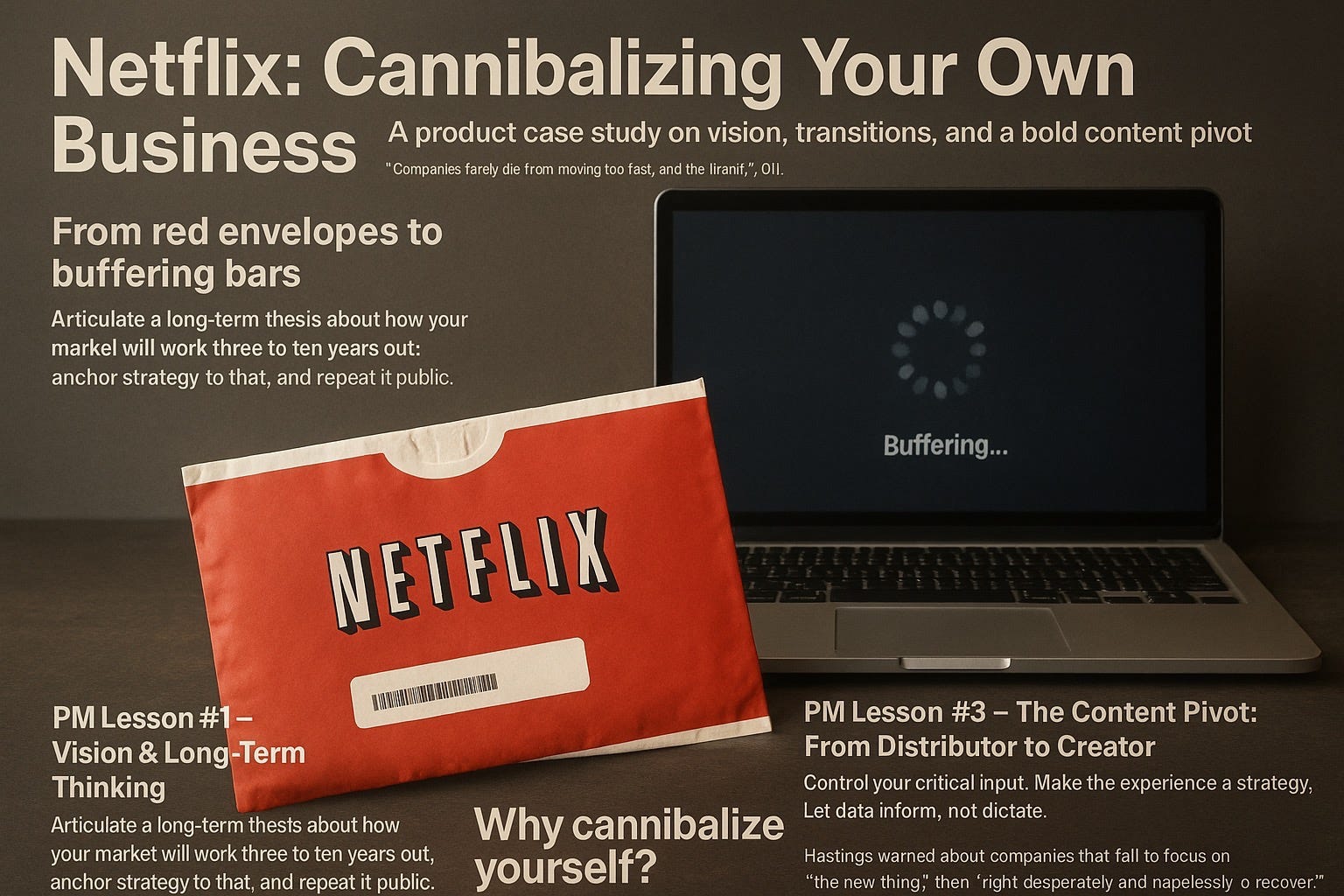
The story in one line
Netflix began as a profitable DVD‑by‑mail company that humbled Blockbuster, then deliberately bet the company on streaming-and later on original content-even though that strategy would ultimately erase its own DVD business. It’s an object lesson in self‑disruption: manage the cannibalization yourself, or someone else will do it for you.
From red envelopes to buffering bars
In 2000, Reed Hastings flew to Dallas to propose that Blockbuster acquire Netflix and let Netflix run Blockbuster’s online strategy; Blockbuster passed. (The New Yorker) A decade later, Blockbuster filed for Chapter 11, crippled by the very shifts Netflix set in motion. (The Guardian)
Netflix launched streaming in 2007 and by Q4 2011 members collectively watched over 2 billion hours, roughly 30 hours per member per month-clear evidence that customer behavior was migrating online. (SEC) Yet the company still had a large, lucrative DVD business. In 2012, Netflix’s Domestic DVD segment generated $1.14B in revenue and $538M in contribution profit (about a 47% margin), while Domestic Streaming generated $2.18B in revenue with $350M in contribution profit (about 16%). International streaming-critical for the future-was intentionally loss‑making at ‑$389M as Netflix invested to seed growth. (SEC)
Those numbers matter. In 2012, DVDs were still the cash cow. Netflix nevertheless stated plainly: “Our core strategy is to grow a streaming subscription business … [and] we have shifted spending away from the Domestic DVD segment to invest more in streaming.” (SEC) That’s cannibalization by design.
The red‑envelope era formally ended on September 29, 2023; fewer than a million subscribers remained, and Netflix let them keep their final discs. (About Netflix)
PM Lesson #1 - Vision & Long‑Term Thinking
Netflix didn’t stumble into streaming; it telegraphed the shift early and often. In its 2013 Long‑Term View memo, Hastings argued that Internet TV would replace linear TV over the coming decades, with apps replacing channels. (Los Angeles Times) And well before that, Netflix had already cultivated an operating system for decision‑making: the now‑legendary culture deck. Sheryl Sandberg called it “one of the most important documents ever to come out of Silicon Valley.” (Harvard Business Review)
The culture deck codified principles-freedom and responsibility, context not control, and a ruthless emphasis on talent density-that supported long‑horizon bets. (The memo still highlights judgment as “looking beyond short‑term fixes in favor of long‑term solutions.”) (Netflix Careers) In other words, if you want to cannibalize your own profit engine, you need a culture that rewards clear‑eyed judgment over quarterly optics.
What to steal for your roadmap:
Articulate a long‑term thesis about how your market will work three to ten years out; anchor strategy to that, and repeat it publicly.
Build culture that unlocks long-term decisions (e.g., fewer rules, more context; no fear of pruning “adequate” performance so you can fund the next S‑curve). (Harvard Business Review)
Accept short‑term financial pain (streaming content costs, international losses) to build long‑run distribution and capabilities. The 2012 net income drop and international losses were a feature, not a bug. (SEC)
PM Lesson #2 - Managing a Painful Product Transition
Running two products for two different customer bases is hard. Netflix tried to formalize the split in 2011: one brand (Netflix) for streaming and a new brand (Qwikster) for DVDs, with separate sites and accounts. Customers revolted. Hastings’ blog letter opened with: “I messed up. I owe everyone an explanation.” (CBS News) Within three weeks, Netflix reversed course: “one website, one account, one password… in other words, no Qwikster.” (Reuters)
The damage was real. In Q3 2011, Netflix lost 800,000 subscribers, and the stock, which had briefly touched $300 in July, closed at $77.37 on October 25. (The Washington Post) Hastings later admitted, “Qwikster became the symbol of Netflix not listening.” (TheWrap)
And yet the direction of travel was never in doubt:
Netflix reworked the customer experience (abandoning the dual‑site idea) while maintaining separate internal segments for operating clarity-Domestic Streaming, International Streaming, Domestic DVD-each with its own contribution margin targets. (SEC)
The company explicitly reallocated spend away from DVDs to streaming content, devices, and international expansion, even as DVDs threw off higher margins. (SEC)
What to steal for your roadmap:
Separate your accounting before you separate your UX. Netflix’s segment reporting and contribution margin discipline kept leaders honest about where value was created-even while the front‑end stayed simple. (SEC)
Prototype transitions with real customers. The Qwikster plan violated a basic UX principle-don’t add steps for your best users. The swift reversal (“one website, one account…”) shows the value of listening and course‑correcting fast. (Reuters)
Own the apology. A direct, personal “I messed up” defused some anger and made space to recover. (CBS News)
Keep the legacy product healthy on purpose. Netflix preserved DVD margin and service quality while investing in the future; AP later noted DVDs still offered a long tail of titles not easily streamed-useful for retention-and closed that business gracefully in 2023. (AP News)
PM Lesson #3 - The Content Pivot: From Distributor to Creator
Streaming was a distribution revolution. But owning must‑have content would determine bargaining power and differentiation. Netflix’s watershed bet came in 2013 with House of Cards-a $100 million two‑season commitment, released all 13 episodes at once to invite binge watching. (The Guardian) The economics were audacious (“$100 million for two 13‑episode seasons”), with the ROI measured in subscriber growth and retention rather than syndication. (The Atlantic)
Chief Content Officer Ted Sarandos made the strategy explicit: “The goal is to become HBO faster than HBO can become us.” (The Verge) Releasing full seasons simultaneously became part of the product’s experience design, not merely a marketing gimmick, and Netflix leaned into the data signals that this approach boosted engagement. (TIME)
Early originals (House of Cards, Orange Is the New Black) became platform signposts; competitors noticed, and the arms race in originals began. This was a massive product strategy shift: Netflix moved up the stack from distribution to creation, with all the capital intensity and risk that implies.
What to steal for your roadmap:
Control your critical input. If suppliers (studios) can pull rights or raise prices, build a path to partial self‑reliance (originals) to stabilize your value proposition. (The Guardian)
Make the experience a strategy. Dropping full seasons reframed how TV could be consumed-an example of product mechanics (release models) as differentiation. (The Guardian)
Let data inform, not dictate. Netflix used viewing data to back big bets without pilots while still exercising editorial judgment-a blend Sarandos has discussed widely. (The Verge)
Why cannibalize yourself?
Because the alternative is slow erosion. Hastings warned about companies that fail to focus on “the new thing,” then “fight desperately and hopelessly to recover.” (AllBusiness.com) Netflix internalized Clayton Christensen’s core lesson from The Innovator’s Dilemma by moving resources toward the disruptor (streaming) before the disruptor was the profit center-and then by disrupting streaming’s supply chain with originals.
The data show the cost of that courage. In 2012, Netflix’s consolidated operating income fell from $376M (2011) to $50M, and net income dropped 92%, as the company ramped content spend and international expansion. (SEC) Many firms would have flinched. Netflix did not.
Practical playbook for PMs
1) Write-and share-your Long‑Term View.
Put in writing what you believe the market will look like in 5–10 years and how you’ll win there. Netflix’s Long‑Term View memo made the strategic destination unambiguous (Internet TV replacing linear). (Los Angeles Times)
2) Run a dual‑track operating model.
Keep segment P&Ls for old and new products. Use clear definitions (e.g., contribution profit = revenue – cost of revenue – marketing) and set explicit investment intentions (e.g., “International will run at a loss through 2013”). (SEC)
3) Protect the customer experience during the transition.
Netflix’s Qwikster misstep shows how easy it is to solve an internal problem (organizational clarity) by creating a biggeruser problem (two logins). The fix-returning to a unified UX-was a textbook correction. (Reuters)
4) Communicate like a human when you blow it.
Short, direct, and personal: “I messed up.” Then explain how you’ll fix it. It’s not just PR; it’s trust infrastructure for future changes. (CBS News)
5) Turn distribution into differentiation.
If your moat is access (other people’s content), it’s temporary. Netflix made format (season dumps), data‑driven greenlighting, and originals part of the product, not just the catalog. (The Guardian)
6) Time your farewell tour.
Netflix ran DVDs profitably for years after streaming took off, then closed the chapter with a user‑friendly gesture (letting subscribers keep their last discs). Kill features or products with grace. (AP News)
What not to copy
Don’t surprise users with price/plan changes tied to added friction. Netflix’s 2011 price hike and Qwikster plan triggered 800,000 lost subs and a 35% single‑day stock drop-proof that sequencing and messaging matter as much as strategy. (ABC News)
Don’t fragment the journey. Especially in transitions, clarity beats cleverness. The “one website, one account” reversal said it all. (Reuters)
Coda: The last red envelope
In April 2023, Netflix announced the final season of DVDs, shipping its last discs on September 29, 2023-a clean ending to a 25‑year run that financed the future. (About Netflix) The Associated Press captured the moment’s symmetry: a once‑iconic service, now overshadowed by a streaming business that produced $31.5B the prior year, while DVDs generated $146M-and a parting gift that let remaining subscribers keep their last titles. (AP News)
One sentence takeaway
Self‑disruption is a product strategy, not a slogan: write the long‑term thesis, give teams the cultural permission to pursue it, manage the messy middle with ruthless customer empathy and segmented metrics, and then invest ahead of the curve-even when it hurts.