

Picture this: you’ve spent two weeks interviewing users, stitching together a careful story about their jobs‑to‑be‑done, and prioritizing outcomes. You’re about to share it when your CEO strolls into the room with the casual menace of a cat carrying a “gift.” “Team, I had an idea in the shower,” they announce. “What if we put the entire dashboard… on a holographic carousel?”
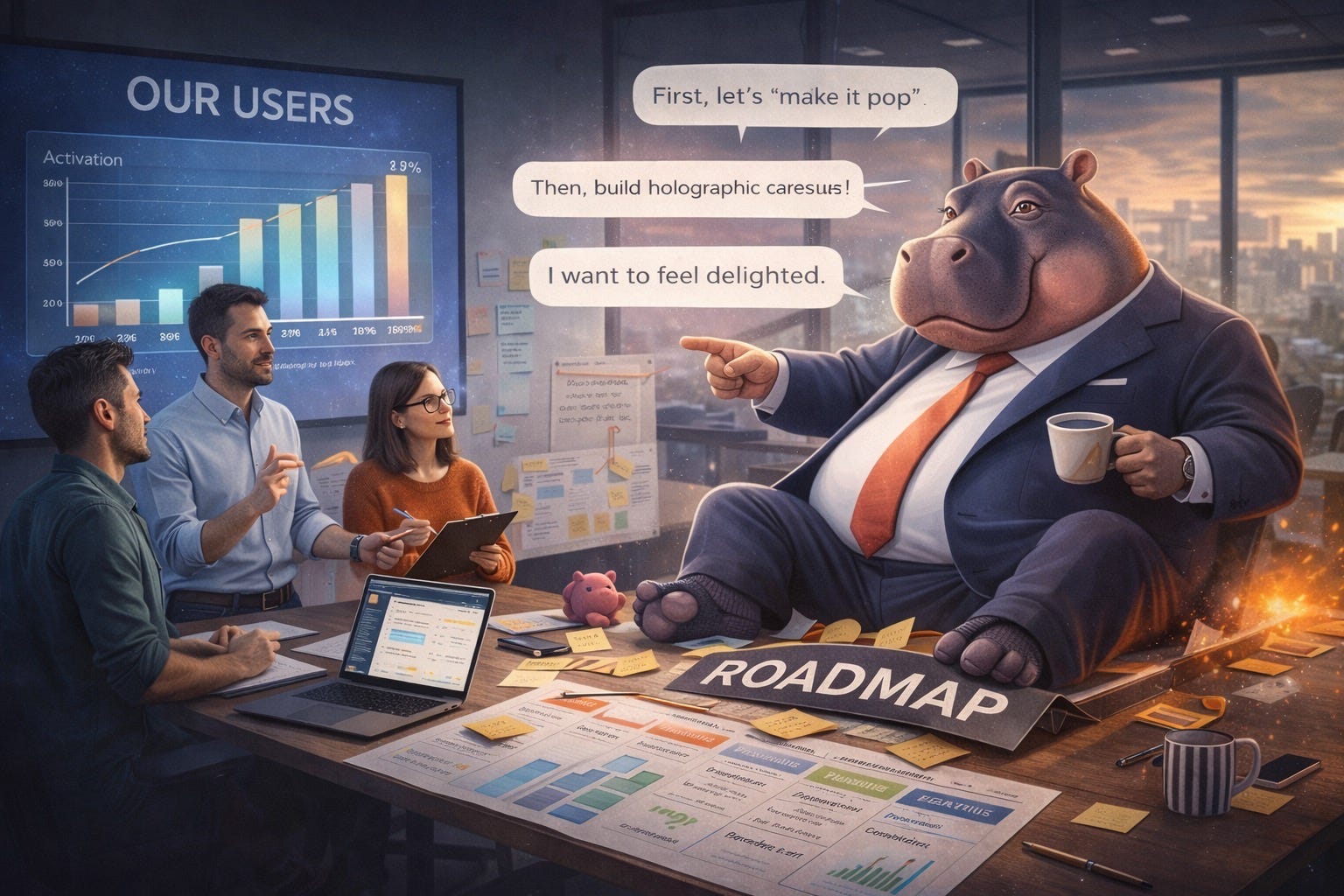
Cue the HiPPO-Highest Paid Person’s Opinion-lumbering majestically across your product strategy. The HiPPO was coined and popularized by experimentation leaders like Ronny Kohavi (who even printed HiPPO stress toys to remind teams to test ideas instead of obey them). The lesson: decisions should be informed by users and experiments, not (just) the org chart. (ExP Platform)
This isn’t a “down with CEOs” screed. Great CEOs set vision, unblock, and raise the bar. But the CEO is not your user, and when you build for the corner office instead of the customer, you pay a tuition you didn’t budget for.
Let’s unpack why the HiPPO is so tempting, what the data says about our intuition, a few real‑world “ouch” stories, and a playbook to keep you (and your roadmap) user‑centered-with a bit of humor to keep the hippos at bay.
Why we keep listening to the HiPPO (and why that’s risky)
1) Authority bias is real. Humans overweight the opinions of authority figures-bosses, experts, charismatic founders-even when evidence is thin. Psychologists call this authority bias. It’s a diagnostic, not a character flaw. Recognize it so you can design around it. (The Decision Lab)
2) Our “gut feel” is less accurate than we think. In large‑scale online experiments at Microsoft and elsewhere, only about one‑third of ideas move the intended metric, another third are neutral, and a third make things worse. Translation: treating a leader’s idea as a sure thing is a great way to collect unplanned learnings-and red dashboards. Controlled experiments convert opinions (including the CEO’s) into testable bets. (Harvard Business Review)
3) We don’t spend enough time with customers to resist the HiPPO. A Pendo survey found 74% of product pros spend fewer than five hours per month with customers-far below the “at least weekly touchpoints” standard many discovery coaches recommend. If the loudest voice is internal, of course it wins. (Pendo.io)
The receipts: cautionary tales of building for the wrong audience
Quibi: “We’ll reinvent TV for phones.”
Founded by Jeffrey Katzenberg and led by Meg Whitman, Quibi raised $1.75B to deliver Hollywood‑grade, mobile‑only “quick bites.” Six months after its April 2020 launch, the service shut down. Critics cited misjudged user habits (mobile video ≠ mobile‑only paid content), limited sharing, and a wobbly feature set for the actual market. It’s a case study in betting on executive instinct over observable behavior (say, what people already did on TikTok and YouTube). (Wikipedia)
Juicero: “Wi‑Fi, but for juice.”
A $400 connected press… for proprietary pouches you could squeeze by hand. Juicero raised around $120M before a 2017 Bloomberg demo torpedoed the premise; the company offered refunds and shut down. When reality (squeezing) beats your value prop (machine), your product was built for a boardroom pitch, not a kitchen counter. (Bloomberg.com)
New Coke: “People prefer sweeter in blind tests.”
In 1985, Coca‑Cola reformulated its flagship after nearly 200,000 consumer taste tests suggested a preference for a sweeter formula. The backlash was instant. Turns out, people weren’t just buying taste; they were buying identity and ritual. A hard lesson in context: test environments can’t capture brand attachment. (To Coke’s credit, they listened and reversed course.) (Coca-Cola Company)
Snap Spectacles: “We’re a camera company now.”
After hype and vending‑machine lines, Snap wrote down ~$40M in unsold Spectacles inventory; media reported hundreds of thousands of units sitting in warehouses, and fewer than half of buyers used them after a month. Early sizzle ≠ product‑market fit. Don’t let launch buzz substitute for sustained use. (The Verge)
If those feel a bit “celebrity fail,” here’s a data‑first counterexample:
Netflix’s thumbs beat stars (by a lot).
In 2017, Netflix A/B‑tested its 5‑star rating against a simple thumbs up/down. Result: 200%+ more ratings activity, which improved recommendations. That wasn’t someone’s opinion; it was a controlled test. (Business Insider)
Friendly reminder: craft matters (and pays off)
Think “customer‑obsessed” is just a slogan? McKinsey’s multi‑year study of 300+ public companies found those in the top quartile of its Business Value of Design index grew revenues 32 percentage points and total returns to shareholders 56 percentage points faster than peers over five years. Great design and user focus don’t just feel good; they show up in P&L. (McKinsey & Company)
Or, as Jeff Bezos wrote: “There are many ways to center a business… obsessive customer focus is by far the most protective of Day 1 vitality.” He also reminds us that many decisions are two‑way doors-reversible-so you can move fast and correct with data. Don’t turn reversible bets into board‑level epics. (About Amazon)
The tell‑tale signs you’re building for the CEO (not the user)
Roadmap items begin as quotes, not problems. “ ‘Make it pop’ by Q3” is not a user need.
Discovery is “that thing we do after the press release.” (You can hear your research lead sobbing in Figma.)
Success criteria are… vibes. “We’ll know it when we see it” works for latte art, not product bets.
You cite one Very Important Person as “the persona.” Congrats, your target market is the executive floor.
If any of the above stung, don’t worry. We’ve all been there. Let’s fix it.
The playbook: user‑centric, data‑driven, CEO‑friendly
1) Make weekly customer touchpoints non‑negotiable.
Book a recurring hour to watch people use your product, interview recent sign‑ups or churns, or shadow support. Bring your designer and lead engineer. Teresa Torres calls weekly touchpoints the minimal standard for continuous discovery. It’s how teams keep their instincts calibrated to reality. (Product Talk)
2) Translate executive ideas into testable hypotheses.
When a leader says “ship the holographic carousel,” reply with:
Hypothesis: Onboarding completion will rise from 62% → 70% because the carousel surfaces key actions sooner.
Test: In‑product A/B with a 10% holdout; success = +8pp completion; guardrail = no drop in 7‑day retention.
This reframes opinion as a bet, which is where the Microsoft/HBR “one‑third improve, one‑third hurt” reality forces healthy humility. (Harvard Business Review)
3) Use two‑way doors to go fast (safely).
Label decisions Type 1 (consequential, hard to undo) vs. Type 2 (reversible). For Type 2, default to shipping the smallest viable test and measuring, not debating. Your CEO likely already believes this; Bezos literally wrote it down. (Q4 Investor Relations)
4) Prioritize with a bias‑reducing framework (and show your math).
RICE (Reach × Impact × Confidence ÷ Effort) came out of Intercom’s attempts to compare unlike ideas fairly. The magic is less the score and more the conversation it forces about user reach and confidence (a perfect place to inject research). Bonus: share the sheet with leadership; sunlight is the best disinfectant for pet projects. (Intercom)
5) Anchor the roadmap to a North Star (so “no” is a service).
Define one North Star Metric that captures customer value (plus 3–5 input metrics you can actually move). When a HiPPO request lands, assess whether it moves an input. If not, you can say “yes-if we drop X, because our NSM is Y.” It’s not insubordination; it’s alignment. Amplitude’s North Star Playbook is a practical primer. (Amplitude)
6) Instrument before you build.
A shocking number of teams bolt on analytics after launch, then wonder why “success” is a mood. For every bet, define leading indicators and guardrails up front. If Netflix can test ratings systems and roll with the results, you can test that onboarding tour. (Business Insider)
7) Tell the story in writing, not just in slides.
A short narrative memo (context → options → trade‑offs → recommendation) calms rooms, aligns stakeholders, and makes HiPPOs read. Amazon normalized this because writing is thinking; it works outside Seattle, too. (About Amazon)
“But my CEO is a power user…”
Lucky you-but that still doesn’t make them the user. They represent N=1, with edge‑case access, enterprise‑grade laptops, perfect Wi‑Fi, and a personal Slack channel called “everyone.” Treat their input as a valuable data point, then triangulate with (a) observed user behavior, (b) market signals, and (c) experiment results. When those align, you’ve got a bet worth escalating.
If you need a polite deflection, try:
The “Yes, if”: “Yes-if we can prototype and test with 50 new users next week; if we see +8pp activation, we’ll scale.”
The “Compare, don’t decide”: “We’ll test your idea alongside two alternatives; we’ll bring back evidence in two sprints.”
The “Door type”: “This is a Type 2 decision; we can ship and measure by Friday. If it’s a miss, we’ll roll back.” (Q4 Investor Relations)
A short, sharp checklist (print this; tape it above the roadmap)
To avoid building for the HiPPO:
Users weekly: At least one real customer touchpoint, every week, with your product trio. (Product Talk)
Hypotheses before handoffs: Every initiative has a user problem, a causal hypothesis, a success metric, and guardrails. (Harvard Business Review)
Two‑way door by default: If reversible, prototype and test; don’t convene the Grand Council. (Q4 Investor Relations)
RICE the backlog: Publish the scoring; force the conversation about reach and confidence. (Intercom)
North Star or it waits: If it doesn’t move the NSM or its inputs, it’s not on this quarter’s plan. (Amplitude)
Real‑world script: defusing a HiPPO in three moves
Scenario: CEO wants to replace onboarding with a 3‑minute sizzle reel because “our story is emotional.”
Reframe as a user problem: “New users don’t reach first value in 24 hours; activation is 62%.”
Offer options: “We can test (A) your sizzle reel, (B) a 3‑step checklist, (C) contextual tips. We’ll A/B/C test 10% of traffic.”
Pre‑commit metrics: “Success = activation +8pp; guardrails = 7‑day retention, support contacts flat.”
Invoke the two‑way door: “Reversible change; if it misses, roll back by end of week.”
Bonus: share a case: “Netflix saw 200%+ more ratings with thumbs vs. stars after testing-simple wins when the data says so. Let’s let the data pick our winner.” (Business Insider)
The CEO still gets to lead; the user gets to vote; and you get to sleep.
Closing thought
A great CEO wants the same thing you do: products people love that drive the business. The fastest way there is to treat opinions-especially powerful ones-as hypotheses and let real customers and experiments decide. Remember:
Authority bias is human; build guardrails against it. (The Decision Lab)
Most ideas don’t work as imagined; design learning loops. (Harvard Business Review)
Customer‑obsessed, well‑designed products outperform over time. (McKinsey & Company)
And if the HiPPO still charges? Offer it a prototype to chew on. They’re surprisingly docile when fed a steady diet of evidence.
Because the CEO can lead the company-but only your users can lead your product.