

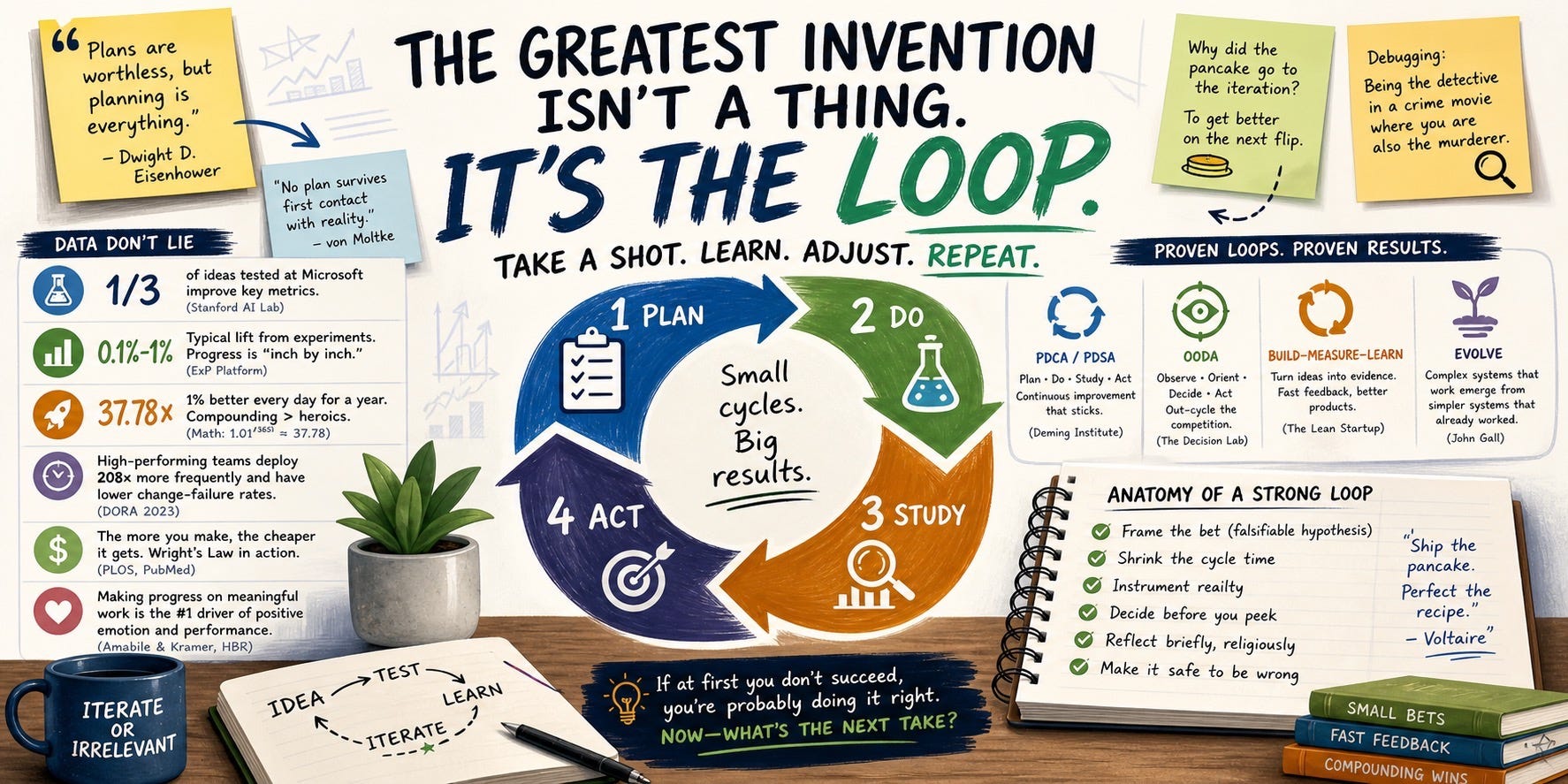
We hand out glory to objects—the wheel, the printing press, the transistor. But the most civilization‑shaping “invention” is a principle: take a shot, learn, adjust, repeat. Call it iteration, PDCA/PDSA, OODA, build‑measure‑learn—the names differ, the loop is the same.
Dwight Eisenhower, who had some experience with high‑stakes plans, put it crisply: “Plans are worthless, but planning is everything.” (The American Presidency Project) Iteration is what makes planning worth doing.
Why iteration beats brilliance (and why your first pancake looks weird)
Brilliance is a spark; iteration is the fire.reality is noisy and nonlinear—assumptions melt on contact. The loop gives you three unfair advantages:
Cheap error discovery. Small, fast cycles reveal where expectations and outcomes diverge while blast radius stays small.
Compounding gains. A humble 1% better per day → 1.01365 ≈ 37.78× better in a year. (Try that with one heroic leap.)
Built‑in adaptability. Markets, rivals, and tech move. Iteration assumes they will; your roadmap is a pencil, not a chisel.
Voltaire warned, “The best is the enemy of the good.” Translation: ship the pancake; perfect the recipe on the next batch. (Wikipedia)
Nature, science, and strategy all agree
Quality & improvement (PDCA/PDSA). Deming’s PDSA cycle—Plan → Do → Study → Act—is a canonical learning loop for continual improvement (rooted in Shewhart). (The W. Edwards Deming Institute)
Decision‑making (OODA). Col. John Boyd’s OODA loop reframed winning as faster, better cycles of Observe–Orient–Decide–Act (not one‑and‑done decisions). (Wikipedia, The Decision Lab)
Product building (Lean Startup). Eric Ries’s build‑measure‑learn loop is iteration formalized for startups and, now, big companies. (The Lean Startup)
Or as systems thinker John Gall summarized (paraphrasing his “law”): complex systems that work emerge from simpler systems that already worked. Start small, evolve. (Wikipedia)
Evidence: iteration prints the receipts
1) Online experiments: most ideas don’t win—so loops matter.
At Microsoft, only ~1/3 of ideas tested in controlled experiments improved their target metrics; many were flat or negative. That’s why you run lots of cycles. (Stanford AI Lab) Ronny Kohavi’s widely cited work shows the same pattern across large‑scale experimentation: progress is “inch by inch,” with typical lifts on key metrics in the 0.1%–1% range. (ExP Platform)
(Humor aside: if every idea in your org is “a slam dunk,” either your bar is on the floor or you’re measuring the wrong hoop.)
2) Design by testing, not arm‑wrestling.
Google famously tested 41 shades of blue on links—an extreme, but memorable, example of letting experiments settle debates. (The Guardian)
3) Software delivery: faster loops, more stability.
A decade of DORA research shows that high performers deploy far more frequently and have lower change‑failure rates—faster loops improve stability when done well. (Google Cloud, Google, RedMonk)
4) Technology progress compounds with experience.
Wright’s Law (statistically supported across many techs) finds costs drop as a power law of cumulative production—a global, industrial‑scale endorsement of iterative learning. (PLOS, PubMed)
5) Psychology of progress: small wins, big motivation.
Amabile & Kramer analyzed ~12,000 work‑day diary entries from 238 people across 7 companies; the strongest driver of positive emotion and performance? Making progress on meaningful work. Iteration manufactures those wins. (Harvard Business School, Harvard Business Review)
6) Reversible decisions accelerate learning.
Amazon’s “two‑way doors” (reversible choices) are tailor‑made for rapid iteration; reserve slow, heavyweight process for one‑way doors. (Q4 Capital)
Objections (and why they don’t survive contact with reality)
“Iteration is dithering.”
Only if your loop never converges. Time‑box cycles, pre‑commit decision rules (“If X, then do Y”), and define kill criteria. Even the Prussian strategist von Moltke cautioned: no plan survives first contact—so plan to re‑plan. (Quote Investigator)
“Vision matters more.”
Vision sets direction; iteration sets velocity. Reid Hoffman’s startup koan—“If you’re not embarrassed by the first version of your product, you’ve launched too late.”—isn’t a license for sloppiness; it’s a call to learn in public. (X (formerly Twitter))
“Some bets are one‑way doors.”
Correct—which is why you prototype the riskiest assumptions (cheaply) before the irreversible step. Simulations, dark launches, and feature flags exist so you don’t test with your whole reputation.
The anatomy of a strong loop (steal this)
Frame the bet. Write a falsifiable hypothesis: “For new users, shorter signup copy will lift completion by ≥3%.”
Shrink the cycle time. Prefer days over weeks; hours over days. (If your code only deploys when the moon is full, your loop is a werewolf.)
Instrument reality. If it isn’t observable, it isn’t learnable.
Decide before you peek. Pre‑commit success metrics and actions to avoid hindsight bias.
Reflect briefly, religiously. Tiny retros: What surprised us? What will we do differently next loop?
Make it safe to be wrong. Celebrate learnings, not just wins—because most “wins” will be modest and many ideas won’t pan out. (Stanford AI Lab, ExP Platform)
Field notes by domain (with receipts)
Software & product.
Continuous discovery & MVPs reduce wasted cycles; that’s the whole point of build‑measure‑learn. (The Lean Startup)
Elite delivery teams iterate faster and break less. (DORA.) (Google Cloud)
Ops & quality.
PDSA has 70+ years of proof in manufacturing and services; it’s literally “learning to learn.” (The W. Edwards Deming Institute)
Strategy & competition.
OODA is loops as advantage: out‑cycle opponents, don’t out‑speeches them. (The Decision Lab)
Economics of building.
Wright’s Law says the more you make, the cheaper/better you get. Translation: ship → learn → repeatlowers your cost curve. (PLOS)
Teams & morale.
Progress Principle: small wins today fuel better work tomorrow; loops produce those wins on schedule. (Harvard Business Review, Harvard Business School)
Practice rules that make iteration win
Bias to reversible moves. Keep one‑way doors scarce. (Q4 Capital)
Don’t debate what you can measure. When in doubt, A/B it. (And expect most ideas to underperform your intuition—humbling but normal.) (Stanford AI Lab)
Optimize for loop time, not meeting time. If your standup lasts longer than your experiment, you’ve reinvented the sit‑down.
Name and codify good takes. When a loop works, turn it into a play: checklist, owner, SLA.
Guardrails > heroics. Feature flags, canaries, and staged rollouts make speed safe—the hallmark of elite teams. (Google Cloud)
Why the loop is the “greatest invention”
Because it creates the others. The printing press without proofreading prints nonsense. The transistor without test benches stays a toy. The loop is the metainvention that turns inspiration into reliability.
Eisenhower again: plans will fail as written; planning (a living loop) is how we’re ready anyway. (The American Presidency Project) Voltaire nudges us to stop worshipping the unreachable ideal. (Wikipedia) And the pragmatic builders—from Toyota to today’s best software teams—prove that frequent, disciplined cycles beat grand gestures over time. (The W. Edwards Deming Institute, Google Cloud)
So celebrate the launch, sure. But worship the loop: short, honest, relentlessly curious. Everything we admire—safety, quality, beauty, profit, even wisdom—arrives not as a single stroke of mastery but as the sum of many takes.
(Final joke, iterated to pass the “mild smile” test): If at first you don’t succeed, you’re probably doing it right. Now—what’s the next take?