

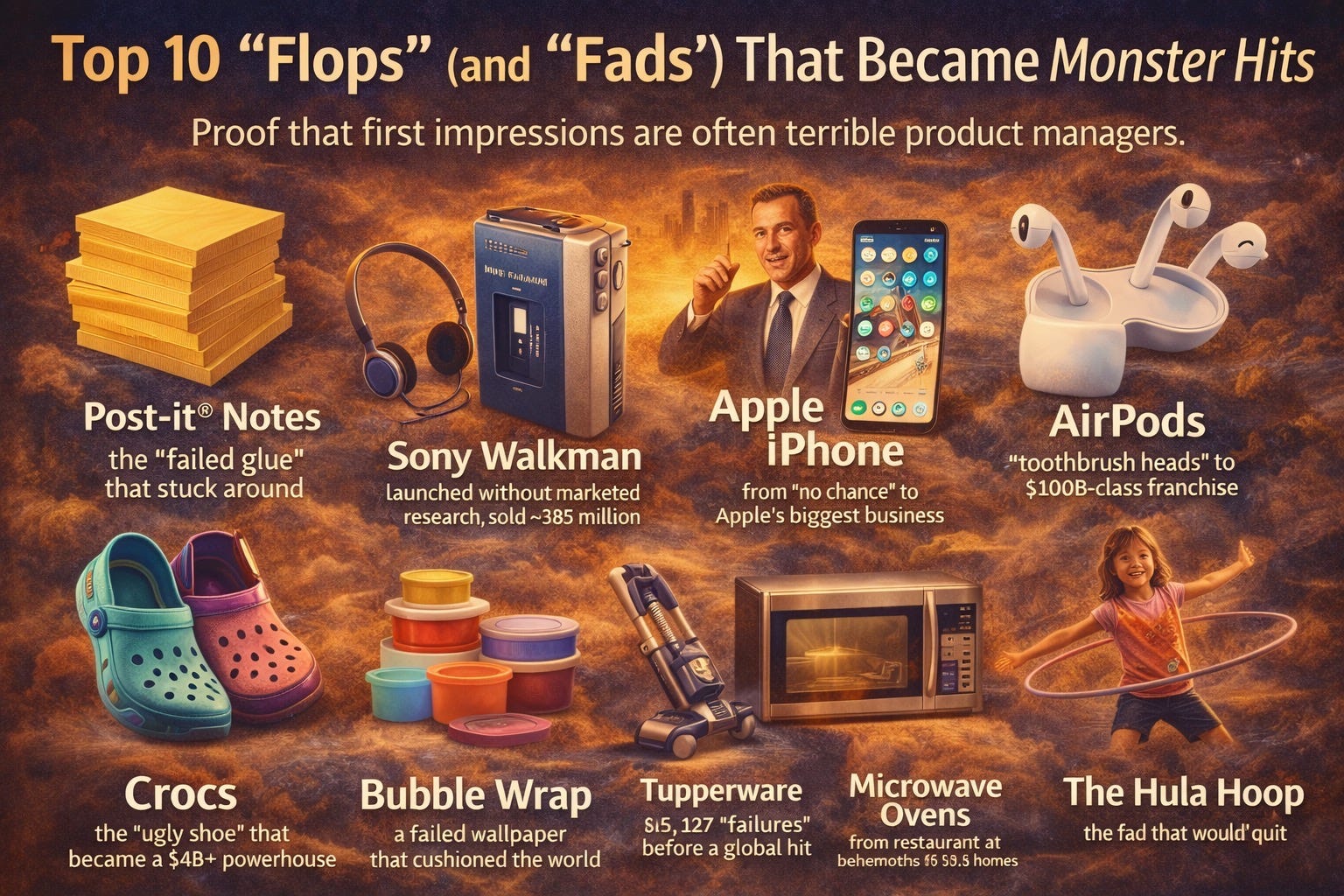
Proof that first impressions are often terrible product managers.
The innovation graveyard is full of ideas that were “obviously dumb” right up until they weren’t. Some were mocked as fleeting fads; others stumbled out of the gate and looked like write‑offs. Then reality happened. Below are ten products that went from punchline to juggernaut—with research, receipts, and a little playful shade for the early naysayers.
1) Post‑it® Notes — the “failed glue” that stuck around
3M set out to make a super‑strong adhesive in 1968 and accidentally created the opposite: a low‑tack, re‑stickable glue. Useful? Not obviously. The first product—Press ’n Peel—hit four test markets in 1977 with “mixed results,” which is corporate for “meh.” Only after a 1978 sampling blitz in Boise (“the Boise Blitz”) did the lightbulb go on; in 1980, the product launched nationally as Post‑it Notes. (Post-it, Minnesota Historical Society)
3M’s own history admits the beginnings were “far from certain.” (Post-it)
The outcome: A canonical office staple born of a “failure”—and a masterclass in changing context (samples + use cases) instead of changing chemistry. (Post-it)
2) Sony Walkman — launched without market research, sold ~385 million
If you’d asked a focus group in 1979 whether they wanted to wear headphones in public, you’d have likely gotten polite laughter. Sony co‑founder Akio Morita didn’t ask. As The Guardian put it: “Neither market research nor focus groups featured anywhere in the Walkman story.” The bet paid off: Sony’s official history tallies 385 million Walkman units shipped across formats. (The Guardian, Sony)
The outcome: When you create a new behavior (“private, portable sound”), people can’t describe it in a survey—but they can buy it by the tens of millions. (Sony)
3) Apple iPhone — from “no chance” to Apple’s biggest business
Microsoft’s Steve Ballmer famously scoffed in 2007: “There’s no chance that the iPhone is going to get any significant market share.” (He also dinged it for lacking a keyboard.) Reality disagreed. Apple sold one million iPhones in 74 days, and by fiscal 2024 the iPhone generated $201.2 billion in revenue—Apple’s largest line item. (WIRED, Q4 Capital)
The outcome: The device Ballmer dismissed became the center of Apple’s financial universe. (And yes, it still doesn’t have a physical keyboard.) (Q4 Capital)
4) AirPods — “toothbrush heads” to $100B‑class franchise
When Apple unveiled AirPods in 2016, the internet’s verdict was savage: “roundly mocked” and meme‑ified as easy‑to‑lose ear‑dangles. Then… they took over. Counterpoint expects cumulative AirPods revenue to cross $100 billion by 2026, and Apple has led the true‑wireless earbuds market for years even as competitors pile in. (The Guardian, Counterpoint Research)
The outcome: From punchline to category synonym. Moral: never bet against frictionless pairing. (Counterpoint Research)
5) Crocs — the “ugly shoe” that became a $4B+ powerhouse
For a while, Crocs were the footwear you wore privately to take out the trash. Fashion writers sneered; thinkpieces called them the “ugliest shoes ever.” And yet the company’s financials tell a happier tale: $4.1 billion in 2024 revenue—a record—after a years‑long resurgence powered by comfort trends and savvy collabs. (Business Insider, investors.crocs.com)
The outcome: From meme to money machine. (Beauty may be subjective; gross margin is not.) (investors.crocs.com)
6) Bubble Wrap — a failed wallpaper that cushioned the world
Two engineers laminated plastic sheets to make textured wallpaper in 1957. The décor idea bombed. They then pitched it as greenhouse insulation… also not the hit. The big break came when Sealed Air repurposed it for protective packaging, with IBM among the early adopters. As Smithsonian summarizes, it was a “failed experiment” that revolutionized shipping—and stress relief. (Sealed Air, Wikipedia, Smithsonian Magazine)
The outcome: From interior‑design miss to indispensable packaging—and the world’s most satisfying office toy. (Smithsonian Magazine)
7) Tupperware — retail flop → living‑room rocket ship
Earl Tupper’s airtight plastic bowls were impressive, but store shelves weren’t moving them in the late 1940s and early 1950s. Enter Brownie Wise, who built the now‑legendary Tupperware Party model: in‑home demos where hosts showed (and sealed) the value. The Smithsonian notes the product simply “was not selling well in stores” until Wise’s direct‑sales approach turned it into a cultural and commercial force. (National Women’s History Museum, Smithsonian Magazine)
The outcome: Distribution innovation mattered more than product innovation. Sometimes the channel is the product. (Smithsonian Magazine)
8) Dyson Vacuums — 5,127 “failures” before a global hit
James Dyson’s bagless cyclone concept was rejected by major manufacturers (that vacuum‑bag cash cow didn’t want disrupting). He built 5,127 prototypes anyway, then launched the DC01 himself in 1993. Within 18 months the DC01 topped the UK market; the brand later expanded into fans, hair dryers, and air purifiers. As Dyson himself put it: “It took 5,127 prototypes and 15 years to get it right.” (WIRED, Dyson, Wikipedia)
The outcome: A lesson in stubbornness as a strategy. (And in transparent dust bins as surprisingly persuasive UX.) (Wikipedia)
9) Microwave Ovens — from restaurant behemoths to 96% of U.S. homes
The first commercial microwaves (late 1940s–1950s) were enormous, water‑cooled, and cost the equivalent of a used car. Adoption was slow; by 1986 only 25% of U.S. households had one. Fast‑forward: by 2015, roughly 96% of U.S. homes had a microwave, according to the Energy Information Administration’s RECS survey. (WIRED, Bureau of Labor Statistics, U.S. Energy Information Administration)
The outcome: Shrink the box, cut the price, and one day it’s the most‑used “chef” in the house. (U.S. Energy Information Administration)
10) The Hula Hoop — the fad that wouldn’t quit
Wham‑O’s plastic hoop exploded in 1958, selling an estimated 25 million in the first four months and ~100 millionwithin two years. Yes, it was the definition of a “craze,” but the hoop kept rolling—revivals, fitness versions, competitions. As History.com puts it, the Hula‑Hoop became a “huge fad”—and a permanent icon. (HISTORY, Encyclopedia Britannica)
The outcome: Some fads don’t disappear; they just stop apologizing for being fun. (Smithsonian Magazine)
Bonus round: “But were they really flops?”
A quick framing:
Flop → hit: The product underperformed or was dismissed, then scaled (Post‑it, Dyson, Tupperware, Bubble Wrap).
Fad → franchise: The product was laughed off as a novelty but sold at wild scale—and in some cases built durable businesses (AirPods, Crocs, Hula Hoop).
Skepticism → dominance: Experts called it misguided; it became a platform (Walkman, iPhone).
In all three lanes, the pivot wasn’t just marketing spin. It was fit found through sampling, channel design, or a new behavior people hadn’t imagined yet. (Post-it, Smithsonian Magazine, The Guardian)
What these “resurrections” have in common
1) They changed the context, not (always) the concept.
Samples (Post‑it’s Boise Blitz), in‑home demos (Tupperware), and re‑framing (Bubble Wrap as packaging) turned idle curiosities into obvious purchases. (Post-it, Smithsonian Magazine, Sealed Air)
2) They hacked time‑to‑value.
AirPods erased pairing pain. The Walkman gave instant private music. Microwave ovens slashed reheat time. In each case, the first five minutes were magic. (The Guardian, Bureau of Labor Statistics)
3) They ignored (or outgrew) early “this will never work” takes.
From Ballmer’s iPhone quip to fashion’s Crocs disdain, confident contrarians won by shipping—and measuring—real usage. (WIRED, Business Insider)
4) They paired product with distribution genius.
New channels matter: Tupperware parties; Sony’s global branding of “Walkman”; Apple’s retail + ecosystem lock‑in for AirPods and iPhone. (Smithsonian Magazine, Sony, Counterpoint Research)
Quick receipts (so your inner skeptic can rest)
Post‑it Notes: Press ’n Peel test had “mixed results”; 1978’s Boise Blitz sampling flipped sentiment; national launch in 1980. (Post-it, Minnesota Historical Society)
Walkman: “No focus groups” origin story; ~385M units sold. (The Guardian, Sony)
iPhone: “No chance” quote; 1M units in 74 days; $201.2B iPhone revenue in FY2024. (WIRED, Q4 Capital)
AirPods: “Roundly mocked” at launch; Counterpoint sees $100B+ cumulative revenue by 2026. (The Guardian, Counterpoint Research)
Crocs: From meme to $4.1B 2024 revenue. (investors.crocs.com)
Bubble Wrap: Wallpaper → insulation → packaging; IBM among early users. (Sealed Air, Wikipedia)
Tupperware: “Not selling well in stores” until Brownie Wise’s party plan. (National Women’s History Museum, Smithsonian Magazine)
Dyson: 5,127 prototypes; market‑leading DC01. (WIRED, Wikipedia)
Microwave: 25% U.S. homes by 1986; ~96% by 2015. (Bureau of Labor Statistics, U.S. Energy Information Administration)
Hula Hoop: 25M in four months; ~100M within two years. (HISTORY, Encyclopedia Britannica)
The (slightly snarky) playbook for your next “flop”
Don’t ask, show. Surveys are great, but the Walkman‑style “ship it and watch” approach has a track record when you’re birthing a new behavior. (The Guardian)
Put the product where belief happens. A sampling blitz (Post‑it), a living‑room demo (Tupperware), or a dead‑simple setup (AirPods) beats another press release. (Post-it, Smithsonian Magazine, The Guardian)
Instrument the first five minutes. Microwaves, Walkman, AirPods, iPhone—winners deliver velocity to value. Measure that moment like it’s your NPS, because it kind of is. (Bureau of Labor Statistics)
Be stubborn (and specific). Dyson’s 5,127 tries weren’t random; they were tight feedback loops. If your “flop” is on the right problem, double down. (WIRED)
Let fads fund franchises. Hula Hoop was a craze—then a category. Crocs was a meme—then a margin machine. Sometimes fashionably “uncool” is a moat. (Encyclopedia Britannica, investors.crocs.com)
Final thought
Every great product has an awkward teenage phase. If yours is being mocked as a fad or dismissed as a flop, take heart: you might be one sampling program, one channel innovation, or one prototype #5,128 away from the list above. Just remember—history is written by the winners…and the people who kept a straight face while gluing office paper with a “failed” adhesive. (Post-it)