

From air mattresses to mice, here are ten once‑ridiculed ideas that shuffled (or slinked) their way into our everyday lives.
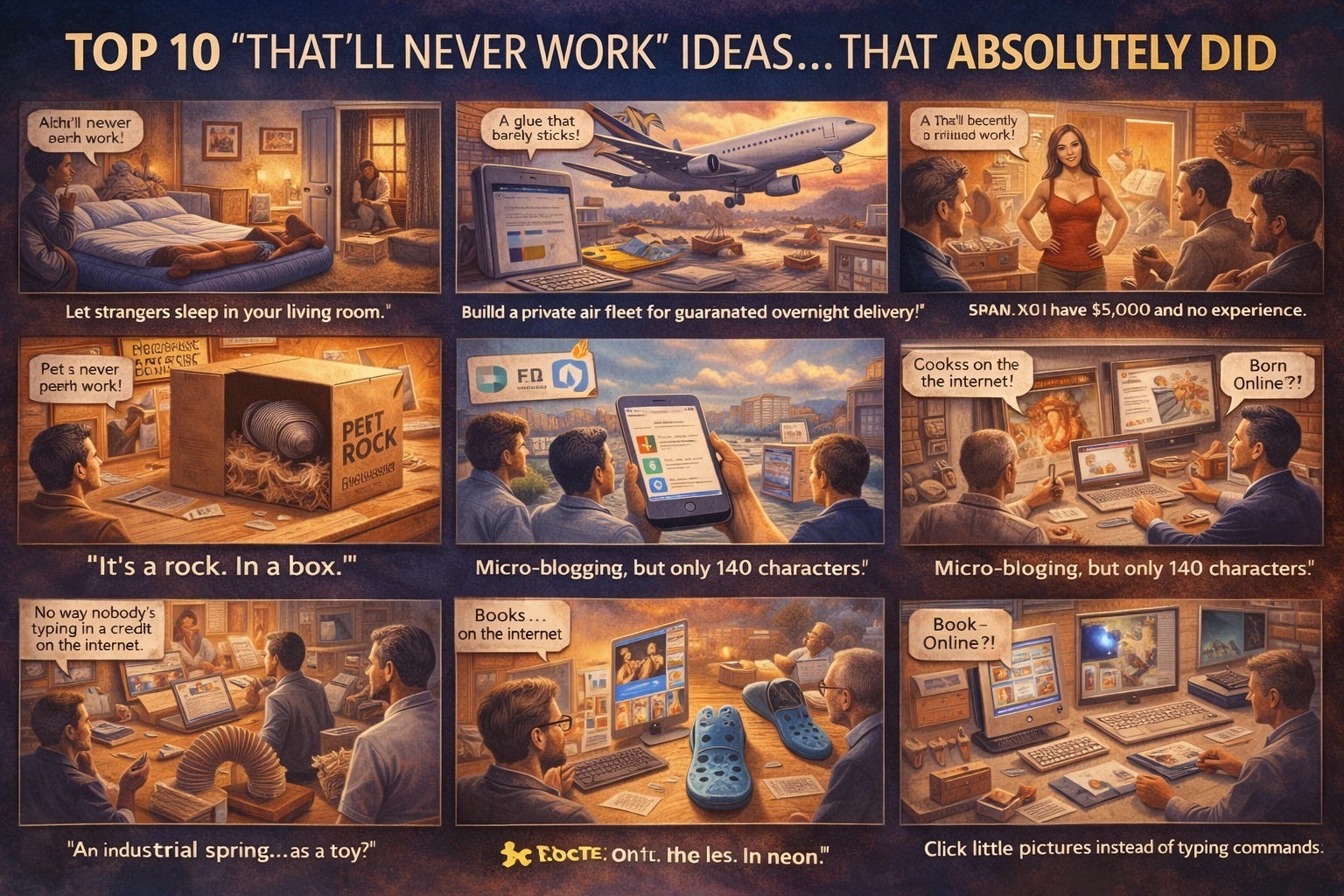
1) Airbnb - “Let strangers sleep in your living room.”
Why it sounded crazy: Hospitality experts assumed trust would be the fatal bug. Investors wondered who would type their credit card into a website and then… hand their keys to a stranger? In 2008 the founders literally kept the lights on by selling limited‑edition political cereal boxes, “Obama O’s” and “Cap’n McCain’s.” (WIRED)
What worked: Airbnb didn’t just build listings; it productized trust (reviews, identity, payments). By IPO day in 2020, the company’s valuation briefly exceeded the combined market caps of Marriott, Hilton, and IHG-an unthinkable outcome when the idea was “airbeds on floors.” (Business Insider)
A little internet color:
“Before Airbnb, the idea was crazy that you’d let strangers into your home.” - Hacker News user (Hacker News)
Nugget: In 2021, analysts estimated Airbnb’s share of U.S. lodging revenue jumped to 18% in 2020 (up from 11.5% in 2019)-evidence that “crazy” can scale fast when the market shifts. (Reuters)
2) Post‑it® Notes - “A glue that barely sticks.”
Why it sounded crazy: In the late 1960s 3M chemist Spencer Silver accidentally invented a very weak adhesive. Inside 3M it was dismissed as a “solution without a problem” for years. Art Fry’s hymnal bookmarks finally gave it purpose, and after early field tests as Press ’n Peel (1977), the product launched nationally in 1980. Also: the now‑iconic Canary Yellow happened because the lab next door had scrap yellow paper. (Skeptical Inquirer)
A little internet color:
“For five years, Silver promoted his ‘solution without a problem’ within 3M…” - Reddit /r/AskEngineers(Reddit)
Nugget: Post‑its are a masterclass in customer education: when 3M sampled them broadly (“try it, then you tell us what it’s for”), adoption exploded. If you’ve ever learned to peel them sideways so they don’t curl-there’s literally a Reddit Life Pro Tip for that. (Reddit)
3) FedEx - “Build a private air fleet for guaranteed overnight delivery.”
Why it sounded crazy: In the 1960s, shipping piggybacked on passenger planes; owning a dedicated network felt financially bonkers. A famous (and debated) legend says founder Fred Smith only got a “C” on the Yale term paper outlining the idea. What’s not debated: on April 17, 1973, Federal Express launched with 14 aircraft, 389 employees, and 186 packages delivered to 25 U.S. cities-and an industry was born. (Quote Investigator)
A little internet color:
“FedEx may have the worst and least secure digital platform for a major company.” - Hacker News user, grumbling half a century later (Hacker News)
Nugget: The hub‑and‑spoke system Smith envisioned as a student ultimately helped power modern e‑commerce. When he passed away in June 2025, obituaries noted FedEx had grown to ~17 million daily deliveries with ~500,000 employees. Crazy… worked. (The Washington Post)
4) Spanx - “A 21st‑century girdle. Also, I have $5,000 and no experience.”
Why it sounded crazy: Mills kept saying no; shapewear sounded dusty. Sara Blakely persisted, got Neiman Marcus to try it, and then Oprah raved-cue hockey‑stick demand. Forbes later named Blakely the world’s youngest self‑made female billionaire. (Allure)
Nugget: The lesson isn’t just persistence; it’s product storytelling. With nothing but a prototype and a pitch, Blakely reframed shapewear from “grandma’s garment” into a confidence device.
5) The Pet Rock - “It’s a rock. In a box.”
Why it sounded crazy: Because it is crazy. Yet Gary Dahl’s satirical “pet care” manual turned a gag into the ultimate case study in packaging and narrative. In late 1975 the fad went nuclear, selling about 1.5 million rocks at $3.95. (The Washington Post)
A little internet color (from the manual itself):
“It takes most PET ROCKS exactly three days to acclimate themselves to their new surroundings.”
Nugget: The product was a rock; the experience was comedy. Dahl’s manual offered deadpan commands like SIT, STAY, and ATTACK-earning a permanent spot in marketing lore.
6) Twitter (now X) - “Micro‑blogging, but only 140 characters.”
Why it sounded crazy: “Who cares what you had for lunch?” The 140‑character limit-born from SMS’s 160‑character cap-seemed laughably restrictive. Then constraints made the medium: real‑time news, citizen journalism, and culture in bite‑size bursts. (Fast Company)
What changed: In 2017 the limit doubled to 280 (and later ballooned for paid tiers). A year in, data showed the average tweet was still just ~33 characters-brevity persisted. (TechCrunch)
A little internet color:
“It is also incredibly bloated considering they only need to display 140 characters and some media.” - Hacker News user, 2016 (Hacker News)
Nugget: Product constraints can birth culture. Hashtags, threads, and @‑replies were user hacks before features-proof that “toy” platforms can become public squares. (WIRED)
7) The Slinky - “An industrial spring… as a toy?”
Why it sounded crazy: In 1943, naval engineer Richard James knocked a torsion spring off a shelf and watched it “walk.” Who would buy a bare spring? In 1945, he demoed it at Gimbels-400 units sold out in 90 minutes. Lifetime sales later topped 300 million. (Lemelson MIT)
Nugget: Slinky is proof that physics can be a product. No lore, no specs-just mesmerizing behavior powered by gravity and momentum.
8) Amazon - “Books… on the internet.”
Why it sounded crazy: In 1995, typing a credit card into a browser felt edgy. The “Earth’s biggest bookstore” was derided as a passing dot‑com. Jeff Bezos’ now‑famous 1997 shareholder letter counter‑programmed Wall Street: “It’s all about the long term.” (Wikipedia)
Nugget: The bet paid off: by 1997, Amazon had served 1.5 million customers and grown revenue 838% to $147.8M-still just the prologue to “the everything store.” (SEC)
9) Crocs - “Foam clogs with holes. In neon.”
Why it sounded crazy: Fashion critics recoiled; the public shrugged. But chefs, nurses, gardeners, and kids discovered the shoes were absurdly practical and comfortable. Crocs leaned into the weird.
Receipts (literally): $4.1 billion in 2024 revenue, a record for the company. Also, the Financial Times noted the brand’s comeback and collaborations helped sustain growth post‑pandemic. (Crocs Investors)
A little internet color:
“Love them, give zero effs about them being ugly. They are so comfy…” - Reddit user (Reddit)
Nugget: When your product’s core value is comfort, you can even win weddings. (Yes, there are Crocs‑at‑the‑altar stories. Internet, never change.) (People.com)
10) The GUI and the Mouse - “Click little pictures instead of typing commands.”
Why it sounded crazy: Early power users scoffed-why point when you can type faster? But Xerox PARC’s Alto (mouse + bitmapped GUI) showed a friendlier way; Doug Engelbart had demoed the mouse and hypertext as early as 1968. Apple’s Lisa (1983) and then the Macintosh (1984) brought the GUI to consumers. (CHM)
A little internet color:
“Keeping your hands on the keyboard… seems like it must be faster.” - Hacker News user (skepticism lives on) (Hacker News)
Nugget: Interfaces are adoption. The mouse + GUI didn’t just make computers nicer-they made them usable for non‑experts, transforming computers from lab tools into household appliances. (Wikipedia)
The pattern behind the “crazy”
Trust is the product. Airbnb didn’t invent spare bedrooms; it engineered reviews, identity, and payments so the risk felt tractable. (And they told a great cereal‑box story on the way.) (WIRED)
Constraints create culture. Twitter’s 140‑character leash birthed a new rhetoric; even at 280, average tweets stayed short. Slinky is literally a constraint (a coiled spring) turned delight. (Axios)
Packaging > parts. Pet Rock sold humor in a cardboard carrier with air holes; Post‑it sold a workflow, not a square of paper. (The Washington Post)
Distribution as a superpower. FedEx’s hub‑and‑spoke system made “tomorrow” a logistics default; Amazon’s early letters telegraphed an everything‑store ambition, then fulfilled it. (FedEx)
Own your weird. Crocs doubled down on ugly-and found identity (and billions). Spanx reframed an unfashionable category. (Crocs Investors)
Bonus bites: short quotes from the hive mind
“Using long threads is an abuse of Twitter format.” - HN user, 2025 (Hacker News)
“I used Airbnb when it first launched… floored that people would actually want to spend the night(s) in a random stranger’s house.” - HN user (Hacker News)
“Post‑it notes were a ‘solution without a problem’-until they weren’t.” - Reddit summary of 3M lore(Reddit)
What should you steal from these stories (legally)?
If people laugh, ask why. Is the laughter about you, or about a broken assumption you can exploit? (Pet Rock literally monetized the punchline.) (The Washington Post)
Prototype the trust system. Reviews, guarantees, defaults, rituals. Your “product” might be the scaffolding that lets customers try the risky thing once. (WIRED)
Tell a legend customers want to repeat. Cereal boxes. Hymnals. A spring that walks. When your story sells the product, CAC gets a lot friendlier. (WIRED)
And if anyone on Reddit or Hacker News calls your idea ridiculous… take heart. Today’s “are you kidding me?” can be tomorrow’s default setting. (Just maybe don’t ship a literal boulder as a subscription service. That has been done.)