

Great product managers keep a toolbox of ideas they return to again and again—principles that help them decide what to build, what to cut, and how to rally a team. The twenty quotes below are the ones PMs repeat in meetings, paste into decks, and lean on when trade‑offs get tough. For each, you’ll find a short bio of the author and a short note on why the line is so enduringly useful in the craft of product.
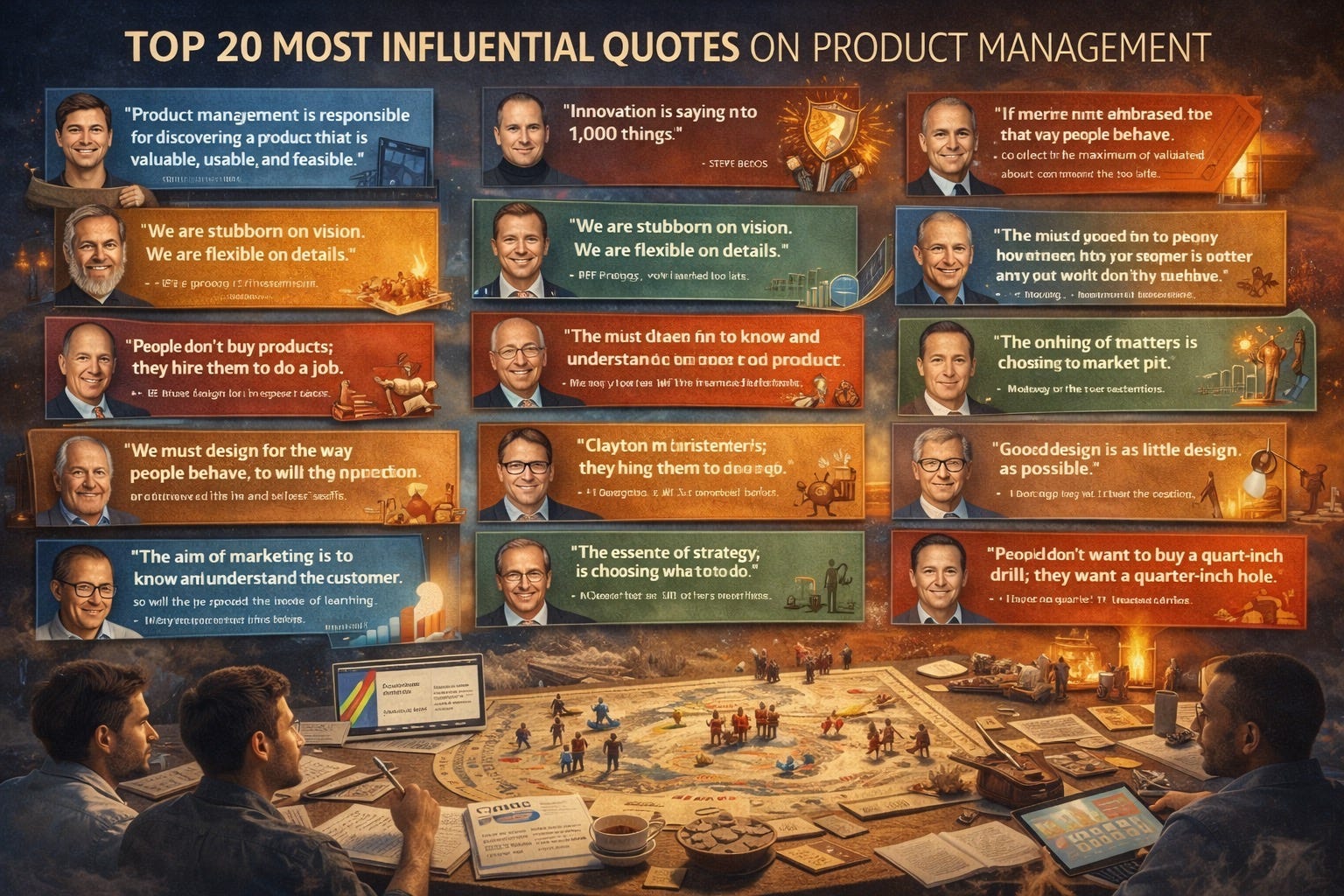
1) “Product management is responsible for discovering a product that is valuable, usable, and feasible.” — Marty Cagan
Who said it (short bio): Marty Cagan is a founding partner at Silicon Valley Product Group, former product leader at eBay and Netscape, and the author of Inspired and Empowered.
Why product managers repeat it: This definition crisply captures the PM’s real job: discovery, not just delivery. “Valuable” centers the customer and the business; “usable” anchors UX; “feasible” respects engineering realities. If your idea doesn’t satisfy all three, it isn’t ready.
2) “Innovation is saying no to 1,000 things.” — Steve Jobs
Who said it (short bio): Steve Jobs co‑founded Apple and led the creation of the Mac, iPod, iPhone, and iPad—products that reshaped consumer technology.
Why product managers repeat it: Focus is the most under‑appreciated superpower in product. This line reminds PMs that strategy is subtraction: every “no” preserves the time and attention needed to make the right “yes” excellent.
3) “We are stubborn on vision. We are flexible on details.” — Jeff Bezos
Who said it (short bio): Jeff Bezos founded Amazon and popularized a culture of long‑term thinking, customer obsession, and working backward from the desired customer experience.
Why product managers repeat it: A good product strategy is a strong “north star” paired with tactical adaptability. This quote legitimizes iteration and pivots without losing sight of the end state you’re building toward.
4) “If you’re not embarrassed by the first version of your product, you’ve launched too late.” — Reid Hoffman
Who said it (short bio): Reid Hoffman co‑founded LinkedIn, is a partner at Greylock, and hosts the Masters of Scalepodcast.
Why product managers repeat it: Perfect is the enemy of learning. Early releases—warts and all—let teams validate demand, discover edge cases, and focus effort where it matters. Shipping creates clarity.
5) “The minimum viable product is that version of a new product which allows a team to collect the maximum amount of validated learning about customers with the least effort.” — Eric Ries
Who said it (short bio): Eric Ries is an entrepreneur and the author of The Lean Startup, a playbook that brought scientific experimentation to product development.
Why product managers repeat it: MVPs aren’t under‑baked products; they’re tightly scoped experiments. This quote reframes MVP as a learning vehicle, not a cheap release—use it to protect your MVPs from bloat.
6) “People don’t buy products; they hire them to do a job.” — Clayton M. Christensen
Who said it (short bio): Harvard Business School professor Clayton Christensen wrote The Innovator’s Dilemma and helped popularize Jobs‑to‑Be‑Done theory.
Why product managers repeat it: Switching perspective from features to “jobs” illuminates unmet needs and competing alternatives. It keeps you from optimizing the wrong thing and helps your product win in the context of the customer’s life.
7) “We must design for the way people behave, not for how we would like them to behave.” — Don Norman
Who said it (short bio): Don Norman is a cognitive scientist and author of The Design of Everyday Things, and was once Apple’s VP of Advanced Technology.
Why product managers repeat it: Real users are busy, distracted, and imperfect. This line urges PMs to ground decisions in observation and evidence, not wishful thinking about “ideal users.”
8) “The aim of marketing is to know and understand the customer so well the product or service fits him and sells itself.” — Peter F. Drucker
Who said it (short bio): Peter Drucker is often called the father of modern management; his ideas have shaped how organizations run and innovate.
Why product managers repeat it: Product and marketing share the same goal: fit. When you deeply understand segments, pains, and contexts, your product narrative writes itself—and acquisition gets far easier.
9) “The essence of strategy is choosing what not to do.” — Michael E. Porter
Who said it (short bio): Michael Porter is a Harvard professor known for the Five Forces framework and foundational work on competitive strategy.
Why product managers repeat it: Roadmaps often fail from over‑commitment, not bad ideas. Porter’s line makes trade‑offs explicit: choosing not to pursue certain segments, platforms, or features is how you achieve differentiation and momentum.
10) “Good design is as little design as possible.” — Dieter Rams
Who said it (short bio): Dieter Rams led design at Braun and formulated the “Ten Principles of Good Design,” influencing generations of product designers.
Why product managers repeat it: Simplicity increases adoption. This quote is a lens for pruning: remove the marginal feature, reduce the configuration, and build defaults that feel obvious.
11) “Your most unhappy customers are your greatest source of learning.” — Bill Gates
Who said it (short bio): Bill Gates co‑founded Microsoft and later the Bill & Melinda Gates Foundation, shaping both software and global health.
Why product managers repeat it: Complaints, cancellations, and churn interviews spotlight the gaps your dashboards gloss over. Lean in—those sharp edges are often your fastest path to retention and growth.
12) “In God we trust; all others must bring data.” — W. Edwards Deming(attributed)
Who said it (short bio): Deming was a statistician and quality pioneer whose ideas fueled modern manufacturing and continuous improvement.
Why product managers repeat it: Opinions (even yours) are cheap; evidence is precious. This line keeps stakeholder debates honest and pushes teams to instrument, experiment, and measure outcomes—not outputs.
13) “Make something people want.” — Paul Graham
Who said it (short bio): Paul Graham co‑founded Y Combinator and is known for essays on startups and product.
Why product managers repeat it: It’s deceptively simple. When you stay close to real user demand, you beat feature anxiety and vanity roadmap items. Demand pulls product; it can’t be pushed.
14) “The only thing that matters is getting to product/market fit.” — Marc Andreessen
Who said it (short bio): Marc Andreessen co‑founded Netscape and investment firm Andreessen Horowitz; he coined “product/market fit” in a seminal essay.
Why product managers repeat it: Before PMF, nothing scales; after PMF, almost everything does. This quote keeps teams focused on the signals that actually matter early: retention, love, organic pull.
15) “People don’t want to buy a quarter‑inch drill; they want a quarter‑inch hole.” — Theodore Levitt
Who said it (short bio): Theodore Levitt was a Harvard marketing professor best known for the classic essay “Marketing Myopia.”
Why product managers repeat it: Outcomes over outputs. It’s a reminder to frame value in the result customers seek—not in the tool you’re proud of building.
16) “The best way to predict the future is to invent it.” — Alan Kay
Who said it (short bio): Alan Kay is a computer scientist who helped pioneer object‑oriented programming and the graphical user interface.
Why product managers repeat it: Vision matters. This line gives PMs permission to lead with a compelling future state and then work backward, instead of waiting for consensus or precedent.
17) “Perfection is achieved, not when there is nothing more to add, but when there is nothing left to take away.” — Antoine de Saint‑Exupéry
Who said it (short bio): Saint‑Exupéry was a French aviator and author of The Little Prince.
Why product managers repeat it: Scope creep is relentless. This quote is your shield: tighten the core use case, reduce mode switches, trim preferences, and make the path to value obvious.
18) “Don’t make me think.” — Steve Krug
Who said it (short bio): Steve Krug is a usability consultant; his book Don’t Make Me Think is the go‑to primer on web usability.
Why product managers repeat it: Cognitive load kills conversion. Every extra decision, field, or label invites drop‑off. This reminder keeps flows intuitive and documentation thin because the product itself explains itself.
19) “Customers will never love a company until the employees love it first.” — Simon Sinek
Who said it (short bio): Simon Sinek is a leadership author and speaker best known for Start With Why.
Why product managers repeat it: Culture shows up in the product. If teams feel rushed, ignored, or misaligned, customers will feel it too. PMs who nurture trust and purpose end up shipping more thoughtful experiences.
20) “Fall in love with the problem, not the solution.” — Uri Levine
Who said it (short bio): Uri Levine co‑founded Waze and authored Fall in Love with the Problem, Not the Solution.
Why product managers repeat it: Attachment to a solution blinds teams to superior options. Anchoring on the problem keeps discovery alive, ideas diverse, and pivots emotionally easier when the evidence points elsewhere.
How to use these quotes in practice
Kick off discovery: Start workshops by reading #6 (Christensen) and #20 (Levine). They reset the room around customer progress, not features.
Prioritize ruthlessly: Use #2 (Jobs) and #9 (Porter) to justify trimming your roadmap and aligning around a sharp strategy.
Accelerate learning: Pair #4 (Hoffman) and #5 (Ries) to frame early releases as experiments and protect MVP scope.
Elevate quality without bloat: #10 (Rams), #17 (Saint‑Exupéry), and #18 (Krug) are your guardrails against complexity.
Align the org: #3 (Bezos) and #19 (Sinek) help you connect mission, culture, and execution—so you can move fast and together.
Stay evidence‑driven: #12 (Deming, attributed) reminds stakeholders that data is a common language when opinions diverge.
Closing thought
Product management lives at the intersection of vision, empathy, and evidence. The lines above endure because they translate complex ideas into navigational beacons you can carry into any stand‑up, review, or board meeting. Pick three or four that address your team’s current challenges—pin them to the top of your docs, put them in your onboarding materials, and revisit them in retros. Over time, they won’t just be quotes; they’ll be part of how your team thinks.