

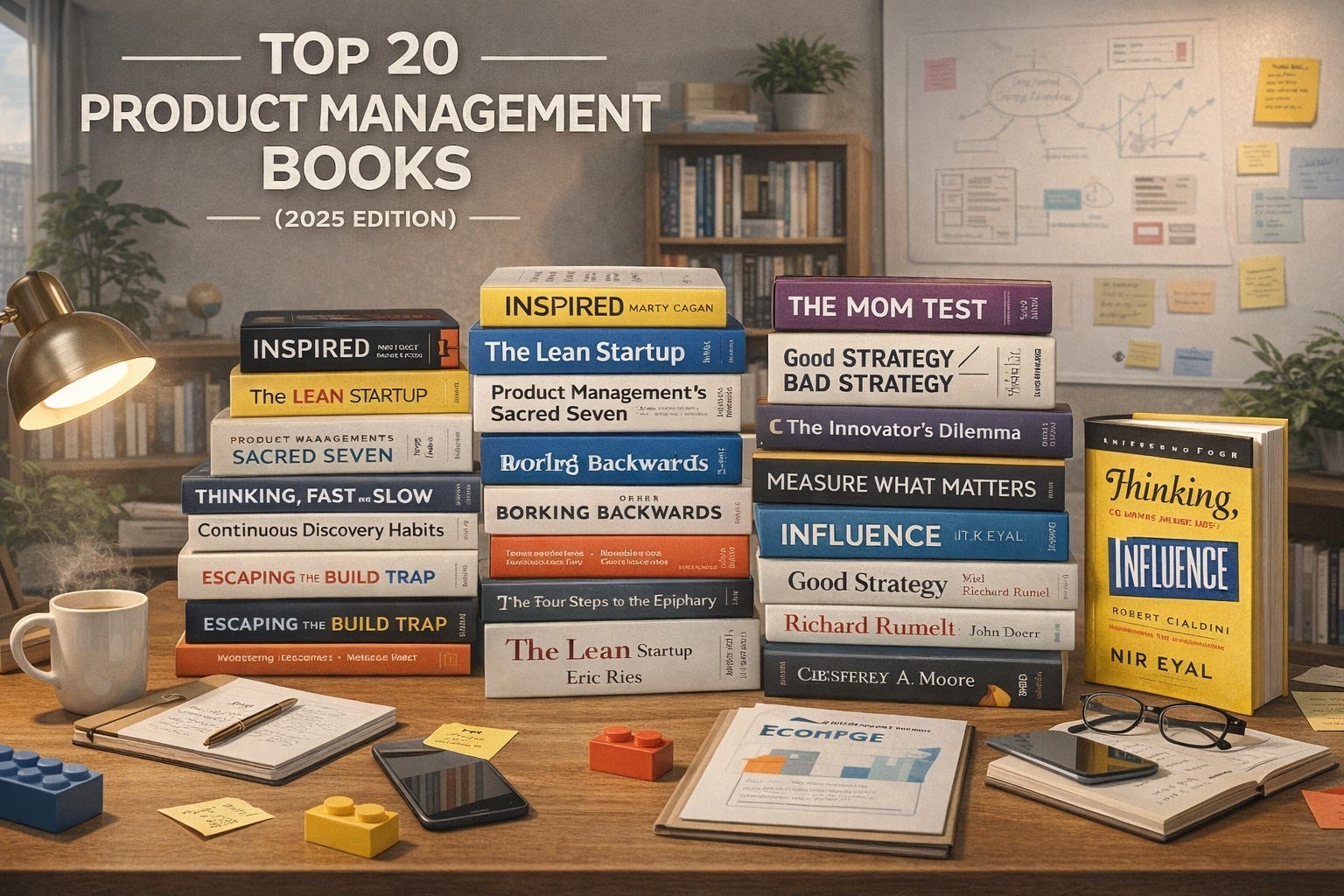
A strong PM bookshelf blends the craft (discovery, roadmaps, execution) with psychology, strategy, economics, and systems thinking. Below is a pragmatic, community‑informed list of 20 books that PMs repeatedly recommend on Reddit’s r/ProductManagement and Hacker News, plus a few data‑backed notes where useful. For each book you’ll find a short description, why it matters, and an Amazon link.
1) INSPIRED - Marty Cagan
What it is: A modern overview of the PM role in tech and how empowered product teams discover and deliver value.
Why it matters: Still the clearest “PM 101” for ICs-use it to align on responsibilities, discovery vs. delivery, and teaming with design/engineering. Many r/ProductManagement threads point new PMs here first. (Reddit)
Amazon. (Amazon)
2) Product Management’s Sacred Seven - Neel Mehta, Parth Detroja & Aditya Agashe
What it is: A comprehensive playbook spanning seven core domains PMs should master-product design, economics, psychology, UX, data, law & policy, and marketing/growth.
Why it matters: Functions like a desk reference you’ll return to for frameworks across disciplines; widely praised on Reddit for breadth and practicality. > “It’s… stuffed with useful knowledge… Best product book I’ve ever read, hands down.” (Reddit)
Amazon. (Amazon)
3) The Lean Startup - Eric Ries
What it is: The build‑measure‑learn loop, MVPs, and hypothesis‑driven development.
Why it matters: Gave teams a common language for validated learning-from startups to enterprises (e.g., GE’s FastWorks). (WIRED)
Amazon. (Amazon)
4) The Mom Test - Rob Fitzpatrick
What it is: A short, practical guide to asking customers non‑leading questions that expose truth and kill false positives.
Why it matters: Perfect antidote to vanity interviews. > “The Mom Test is one of those books that have a lot of good advice.” (Hacker News)
Amazon. (Amazon)
5) Continuous Discovery Habits - Teresa Torres
What it is: A sustainable weekly cadence for discovery-opportunity solution trees, assumption tests, and simple rituals teams can keep up.
Why it matters: The most actionable “how” for ongoing discovery; often cited by PMs as a habit‑forming upgrade to their practice. (Reddit)
Amazon. (Amazon)
6) Escaping the Build Trap - Melissa Perri
What it is: Why organizations ship features for their own sake-and how to pivot toward outcomes and value.
Why it matters: If your roadmap is a feature factory, this book gives you strategy and feedback loops to reset. (Melissa Perri)
Amazon. (Amazon)
7) Working Backwards - Colin Bryar & Bill Carr
What it is: Amazon’s mechanisms (PR/FAQ, six‑page narratives, Bar Raisers) and the principles behind them.
Why it matters: Even if you don’t adopt six‑pagers wholesale, the press‑release‑first mindset forces customer clarity. > “The essay will be read… quietly… typically for 30 minutes or more.” (Hacker News)
Amazon. (Amazon)
8) The Four Steps to the Epiphany - Steve Blank
What it is: The original customer development handbook that heavily influenced Lean Startup.
Why it matters: Structure for getting out of the building, de‑risking, and validating before scaling. (Amazon)
Amazon. (Amazon)
9) Crossing the Chasm (3rd ed.) - Geoffrey A. Moore
What it is: How disruptive products make the leap from early adopters to the mainstream, and how to pick a beachhead.
Why it matters: A marketing/positioning framework PMs still use to plan segmentation and adoption. > “Shaped my understanding of who buys what when.” (Hacker News)
Amazon. (Amazon)
10) The Innovator’s Dilemma - Clayton M. Christensen
What it is: Why great companies fail amid disruptive innovations from below; the theory behind “disruption.”
Why it matters: Helps PMs see when sustaining the core won’t win-and to look for new value networks. (Amazon)
Amazon. (Amazon)
11) Good Strategy/Bad Strategy - Richard Rumelt
What it is: A crisp definition of strategy (diagnosis → guiding policy → coherent actions) and what isn’t strategy.
Why it matters: Cuts through vision‑statement fog and forces hard choice‑making. > “Good definitions of what is or is not a strategy.” (Hacker News)
Amazon. (Amazon)
12) Measure What Matters - John Doerr
What it is: Case‑driven introduction to OKRs (Objectives & Key Results), popularized at Google and beyond.
Why it matters: Done well, OKRs align teams on outcomes (not output). Community discussions highlight pitfalls-e.g., don’t tie compensation to OKRs and avoid “metric gaming.” (Hacker News)
Amazon. (Amazon)
13) Thinking, Fast and Slow - Daniel Kahneman
What it is: System 1 (fast) vs. System 2 (slow), heuristics and biases, and how humans actually decide.
Why it matters: PMs interpret noisy data, price products, and design flows-Kahneman sharpens judgment under uncertainty. (He died in March 2024; obituaries recap his influence on behavioral economics.) (The Guardian)
Amazon. (Amazon)
14) Influence (New & Expanded) - Robert Cialdini
What it is: Six universal principles of persuasion with updated research and applications.
Why it matters: Ethical influence is central to activation, onboarding, and stakeholder alignment. Use as design constraints, not dark patterns. (Amazon)
Amazon. (Amazon)
15) Nudge (Final Edition) - Richard H. Thaler & Cass R. Sunstein
What it is: Behavioral economics applied to policy and product-how choice architecture shapes outcomes (updated in 2021).
Why it matters: PMs set defaults and craft flows that materially change behavior; this is a guide to doing it responsibly. (Penguin Random House)
Amazon. (Amazon)
16) The Design of Everyday Things (Revised & Expanded) - Don Norman
What it is: The classic on human‑centered design, mental models, affordances, and feedback.
Why it matters: Even data‑heavy B2B products are experienced by humans; this book helps you make interfaces that communicate effectively. (Amazon)
Amazon. (Amazon)
17) Thinking in Systems - Donella Meadows
What it is: A readable primer on feedback loops, stocks/flows, delays, and leverage points.
Why it matters: Products live inside complex org, market, and technical systems. Systems literacy reveals non‑obvious levers. > “It changed how I think about everything.” (Hacker News)
Amazon. (Amazon)
18) Hooked - Nir Eyal
What it is: The Hook model-Trigger → Action → Variable Reward → Investment-for habit‑forming products.
Why it matters: Offers a simple retention lens; apply ethically. WIRED’s explainer is a quick overview of the four‑step cycle. (WIRED)
Amazon. (Amazon)
19) Accelerate - Nicole Forsgren, Jez Humble & Gene Kim
What it is: Rigorous research into what makes high‑performing technology organizations-and four key software delivery metrics (a.k.a. DORA metrics).
Why it matters: Shipping speed and stability are product capabilities. DORA identifies four “Four Keys” metrics-Deployment Frequency, Lead Time, Change Failure Rate, Time to Restore-and finds that elite teams are twice as likely to meet or exceed org performance goals. (Dora)
Amazon. (Amazon)
20) High Output Management - Andrew S. Grove
What it is: Intel’s legendary CEO on managerial leverage, one‑on‑ones, task‑relevant maturity, and managing by outputs.
Why it matters: PMs lead through others; Grove’s playbook clarifies how to amplify a team’s output. > “A classic… good for the fundamentals.” (Hacker News)
Amazon. (Amazon)
Why these 20 (and how to use them)
Core PM craft - INSPIRED; Product Management’s Sacred Seven; Continuous Discovery Habits; Escaping the Build Trap; Four Steps; Lean Startup; Working Backwards.
These recur in “what should a new PM read?” threads and offer a solid base across role clarity, discovery cadence, and Amazon‑style writing mechanisms (PR/FAQ and narratives). (Reddit)Strategy & economics - Good Strategy/Bad Strategy; Crossing the Chasm; Innovator’s Dilemma; Measure What Matters; Nudge.
Together they give you language for segmentation, disruption, and outcome‑based goal‑setting-tempered by community caveats about OKR misuse. (Hacker News)Psychology, design, systems - Thinking, Fast and Slow; Influence; The Design of Everyday Things; Thinking in Systems; Hooked.
These sharpen product sense: how people decide, how interfaces communicate intent, how habits form, and how systems create (or thwart) leverage. (The Guardian)Execution engine - Accelerate; High Output Management.
If you want to ship faster and safer, use DORA’s Four Keys as your scoreboard and adopt Grove’s principles for managerial leverage. (Dora)
A few “apply tomorrow” tips
Turn ideas into 1‑pagers. Create reusable templates: an Opportunity Solution Tree for discovery (Torres), a PR/FAQ outline for new bets (Amazon’s “working backwards”), and a Rumelt‑style strategy memo (diagnosis → guiding policy → coherent actions). (Amazon)
Instrument delivery as a product capability. Track the Four Keys-deployment frequency, lead time, change failure rate, time to restore-and review them alongside product metrics. Google Cloud’s summary is a handy reference. (Google Cloud)
Apply behavioral insights ethically. Use Influence, Nudge, and Hooked to reduce friction and create value-not to coerce. (WIRED’s overview of the Hook model is a quick refresher.) (WIRED)