

The product lesson behind one of tech’s most painful slow-motion declines
Evernote did not fail because people stopped taking notes.
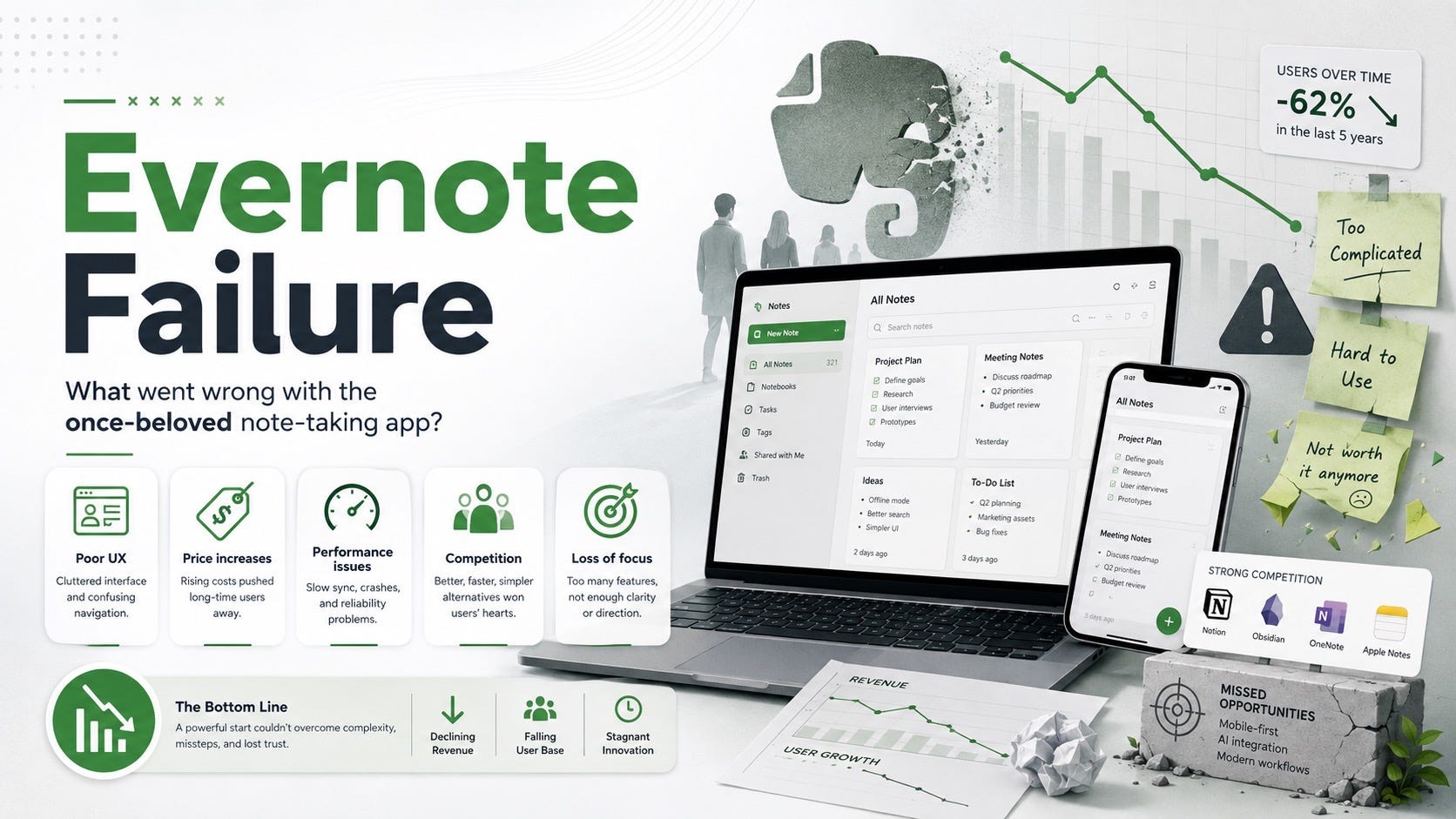
That would be like saying gyms fail because humans stopped feeling guilty in January.
Evernote failed because it slowly broke the emotional contract it had with users. The product promised to be an external brain: fast, reliable, searchable, cross-platform, private, and always there. Over time, many users felt it became slower, more expensive, more complicated, less trustworthy, and less essential.
The tragedy is that Evernote was not a bad product. Quite the opposite. It was one of the most important productivity apps of the smartphone era. Before Notion became a Lego set for overachievers, before Apple Notes became “good enough,” before Obsidian turned note-taking into a spiritual retreat for Markdown monks, Evernote was the default place where your thoughts went to become organized.
For many people, Evernote was not an app.
It was a memory prosthetic with an elephant logo.
And then the elephant started forgetting why people loved it.
The original magic: capture everything, find it later
Evernote’s early genius was beautifully simple: capture anything, then find it later.
Web pages. Meeting notes. Receipts. Business cards. PDFs. Voice memos. Photos. Half-baked startup ideas written at 12:41 a.m. after too much coffee and one YouTube video about “passive income.”
Evernote handled all of it.
In 2011, Wired profiled Evernote as a freemium success story and quoted founder Phil Libin’s philosophy: “It’s more important that you stay than you pay.” That line captured the original magic of Evernote’s business model. The company did not need to squeeze users immediately. The longer users stayed, the more valuable Evernote became.
Notes accumulated.
Memories accumulated.
Switching costs accumulated.
Eventually, some users paid because leaving Evernote felt like moving houses, except every box contained your brain.
By 2013, Wired reported that Evernote had more than 65 million users and described Libin’s ambition to make Evernote an “extension of the brain.” That was a huge vision. Evernote did not merely want to be a note-taking app. It wanted to become the Nike of your mind.
Which sounds inspiring.
Also slightly like something a barefoot CEO would say on a conference stage next to a fern.
But the ambition mattered. Evernote was not trying to build a utility. It was trying to build trust, habit, and identity.
That is why its decline hurt so much.
TL;DR: Evernote did not die. It became less inevitable.
Evernote still exists. It still has paying users. Under Bending Spoons, it has been rebuilt, redesigned, and pushed toward a more aggressive business model.
But Evernote failed against its original promise.
It promised permanence, simplicity, speed, privacy, and trust. Over time, too many users experienced the opposite: friction, complexity, pricing anxiety, missing workflows, and uncertainty.
The core lesson is simple:
A productivity product does not fail when competitors add more features. It fails when users stop trusting it with their future.
Mistake 1: Evernote expanded before fully protecting the core
Evernote’s core value proposition was almost perfect:
Write it down. Store it. Find it.
That was the product.
But successful products attract temptation. Once a company has traction, the roadmap starts whispering dangerous things:
“Let’s become a platform.”
“Let’s add collaboration.”
“Let’s launch a marketplace.”
“Let’s make socks.”
And yes, Evernote really did experiment with physical products and lifestyle extensions, including notebooks, scanners, bags, and other accessories. The company wanted to become more than software. It wanted to become a productivity brand.
The problem was not ambition. Ambition is good. Without ambition, every product roadmap becomes “fix bugs, add dark mode, schedule another alignment meeting.”
The problem was sequencing.
Users depended on Evernote for speed, sync, search, offline access, editing, and reliability. Those were not just features. They were the foundation. When those parts felt weak, everything else felt like decoration on a cracked wall.
For a notes app, reliability is not a backend metric. It is the product.
If users cannot quickly capture a thought, the moment is gone.
If sync fails, trust is gone.
If search disappoints, the whole “remember everything” promise collapses into “misplace everything, but digitally.”
The product lesson: when your product becomes part of someone’s personal infrastructure, the boring features become sacred.
Mistake 2: The free model became emotionally complicated
Evernote was once one of the best examples of freemium done right. The free plan was generous, useful, and habit-forming. People could use Evernote casually, then gradually become deeply invested.
That worked brilliantly until the economics became harder.
In 2016, Evernote changed the free plan by limiting Basic users to syncing across two devices and raising paid plan prices. MacRumors covered the change, while Ars Technica described it as a major shift in Evernote’s freemium strategy.
From a business perspective, the move was understandable. Cloud infrastructure costs money. Product development costs money. Customer support costs money. A large free user base does not magically become profitable because someone in finance adds “viral loop” to a spreadsheet.
But from a user perspective, the change felt personal.
This is the danger with productivity tools. Users do not see their stored notes as your monetization surface. They see them as their life.
A pricing change in a normal SaaS product may feel annoying.
A pricing change in a personal knowledge product can feel like the app is charging rent on your memories.
That tension became even sharper in 2023, when Evernote announced that Free accounts would be limited to 50 notes and one notebook. Evernote said existing free users above the limit could still view, edit, export, share, and delete existing notes. But for many users, the free plan became less of a product and more of a lobby with a velvet rope.
It may have helped monetization.
But it changed the emotional meaning of the product.
Evernote went from:
“Your external brain.”
To:
“Your external brain, now with a storage quota and mild existential dread.”
Mistake 3: Privacy trust took a serious hit
Evernote’s brand depended on trust. People stored personal notes, business plans, journals, legal thoughts, medical notes, receipts, passwords they absolutely should not have stored there, and resignation letters they wisely never sent.
That is why the 2016 privacy controversy hurt so much.
Evernote announced privacy policy changes related to machine learning that could allow some employees to review user notes to make sure the technology worked properly. TechCrunch reported on the backlash, and then reported that Evernote reversed the policy shortly afterward.
To Evernote’s credit, the company listened and walked back the change. But trust is not restored like a password reset.
For a notes app, privacy is part of the user experience. It is not just a policy buried below 4,000 words of legal oatmeal. Users need to feel safe putting their thoughts into the product.
The privacy issue was especially damaging because Evernote’s original promise was intimate. This was not a weather app asking for location permission for the 48th time. This was a product that wanted to be your second brain.
When a second brain creates privacy anxiety, people start shopping for a third brain.
Mistake 4: The rebuild broke too many old habits
In 2020, Evernote launched a rebuilt generation of apps across platforms. The strategic logic made sense. Maintaining multiple legacy apps is expensive. Technical debt grows quietly until one day your codebase looks like an archaeological dig with login buttons.
Evernote needed modernization.
But modernization is dangerous when users have years of workflows built into the old product.
Evernote’s own State of the Product update acknowledged that its releases had not gone as smoothly as hoped. Users complained about missing features, performance issues, offline limitations, export friction, and broken power-user workflows.
This is one of the hardest product management lessons:
A technically correct rewrite can still be a customer experience failure.
Engineers may see a cleaner architecture.
Users see a missing keyboard shortcut.
Product leaders may see a unified platform.
Users see the workflow they used every day suddenly gone.
For casual users, a missing feature may be mildly annoying. For power users, it can be catastrophic. A search operator, export format, local notebook, tagging behavior, or bulk-editing flow may represent years of muscle memory.
Changing that without enough continuity is not just a redesign.
It is eviction.
Mistake 5: Competitors became “good enough” or better
Evernote also suffered because the market got dramatically better.
Apple Notes became surprisingly capable. Microsoft OneNote remained powerful and deeply integrated into Microsoft’s ecosystem. Google Keep handled lightweight capture. Notion became the flexible workspace for teams and creators. Obsidian won over local-first, Markdown-loving power users. Bear, Craft, Joplin, Notesnook, UpNote, and others each found their niche.
The note-taking market stopped being “Evernote or chaos.”
It became a menu.
The Verge’s guide to the best note-taking apps shows how broad the category has become. Users can now choose based on privacy, simplicity, collaboration, local storage, Markdown support, AI features, price, or ecosystem fit.
That matters because Evernote’s switching costs used to be its moat. Once your archive lived there, leaving felt painful.
But when enough frustration accumulates, pain flips direction. Staying becomes more painful than leaving.
That is the moment a moat becomes a trap.
And users start building bridges out.
Mistake 6: The business became a turnaround story
Evernote’s decline was not only about product decisions. It was also about business pressure.
In 2022, Evernote announced that Bending Spoons would acquire the company. TechCrunch described the acquisition as the end of a long, uneven chapter for one of the most famous productivity apps.
Then in 2023, TechCrunch reported that Bending Spoons laid off 129 Evernote employees. The most revealing line came from an Evernote spokesperson, who said the company had been “unprofitable for years.”
That quote matters.
It reframes the story.
Evernote was not merely a beloved product that made some unpopular choices. It was also a business that struggled to convert love into sustainable economics.
This is the uncomfortable truth for many consumer productivity apps:
Being useful is not the same as being profitable.
Having millions of users is not the same as having a healthy business.
Being iconic is not the same as being inevitable.
Evernote had a huge brand, a loyal user base, and a clear use case. But the business model still became difficult enough that the product had to be reshaped around survival.
And survival rarely feels delightful to users.
The deeper failure: Evernote lost confidence
The common explanation is that Evernote failed because it became bloated.
That is partly true.
But the deeper failure was confidence.
Users lost confidence that Evernote would stay fast.
They lost confidence that pricing would remain reasonable.
They lost confidence that workflows would not break.
They lost confidence that privacy decisions would be handled carefully.
They lost confidence that Evernote was the safest place to put the next ten years of their notes.
That last point is crucial.
A note-taking app is not just competing for today’s note. It is competing for tomorrow’s trust.
Every time a user captures something important, they are making a small bet that the product will still serve them later. Evernote became a riskier bet.
Once that happened, competitors did not need to be perfect.
They just needed to feel safer, simpler, cheaper, or more aligned with the user’s needs.
Product lessons from Evernote
1. Protect the core promise
Evernote’s core promise was “remember everything.” That meant capture, sync, search, speed, and reliability had to be sacred.
Before expanding into new categories, product leaders need to ask:
Are we making the core stronger, or are we decorating around unresolved pain?
A product can survive missing nice-to-have features.
It cannot survive breaking the reason people hired it.
2. Do not monetize in a way that feels like a hostage situation
Charging for premium features is fair.
Charging users in a way that makes them anxious about years of accumulated data is dangerous.
The more personal the product, the more careful pricing changes must be. Notes, photos, files, and memories are emotionally different from analytics dashboards or CRM seats.
Nobody wants to feel like their grocery list and life plans are being held behind a velvet SaaS rope.
3. Rewrites must protect existing workflows
Technical debt matters. But so does workflow debt.
If users have spent years building habits around your product, a rewrite should not make them feel like strangers in their own house.
Modernization must come with migration paths, feature parity planning, communication, and empathy for power users.
Otherwise, “new and improved” becomes “new and where did everything go?”
4. Trust is a feature
Privacy, data portability, export options, offline access, and transparent communication are not legal or operational side quests.
They are product features.
Especially for software that stores personal knowledge.
Trust is not what users read in the privacy policy. Trust is what they feel when they decide where to write something important.
5. Competition does not need to beat you everywhere
Notion did not need to beat Evernote at classic note capture.
Apple Notes did not need to beat Evernote at advanced organization.
Obsidian did not need to beat Evernote at mainstream simplicity.
Each competitor only needed to win a specific user need better than Evernote did.
That is how category leaders lose: not all at once, but segment by segment.
Final thought: the elephant forgot the job
Evernote’s story is not just about a note-taking app. It is about what happens when a beloved product becomes too ambitious, too complex, too commercially pressured, and too inconsistent to preserve the thing users originally loved.
Evernote wanted to be a 100-year company. That was a beautiful ambition.
But lasting 100 years requires more than vision.
It requires protecting the core promise every single day.
For Evernote, that promise was simple:
Remember everything.
The irony is that Evernote’s biggest mistake may be that it forgot.
I embedded 10 external links directly in the post. The key factual points are supported by sources on Evernote’s early freemium model, user growth, pricing changes, privacy backlash, acquisition, layoffs, free-plan limits, and competitive landscape. (WIRED)