

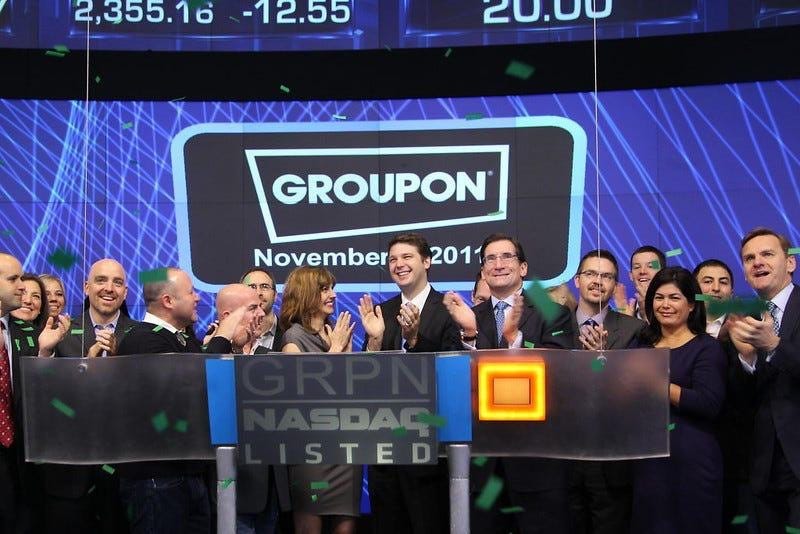
In 2011, Groupon was one of the fastest-growing companies in history.
Valuation: ~$13 billion at IPO
Revenue growth: nearly 2,000% year-over-year in early years
Subscribers: tens of millions globally
Andrew Mason, its quirky founder, was hailed as the next tech visionary.
And yet…
Within a few years, Groupon became a punchline—synonymous with spammy emails, one-time deals, and struggling merchants.
So what happened?
This isn’t just a story about a failed company.
It’s a masterclass in fragile product-market fit, broken unit economics, and growth that outruns reality.
1) The Idea Was Brilliant (and Perfectly Timed)
Groupon’s core insight was deceptively simple:
Aggregate demand → unlock massive discounts → take a cut.
It launched in the shadow of the 2008 Financial Crisis, when:
Consumers were highly price-sensitive
Local businesses were desperate for foot traffic
Email marketing was still underutilized
Daily deal emails felt like a cheat code:
“50% off sushi tonight”
“$100 spa package for $40”
Conversion rates were insane.
A widely cited stat from the era:
Early Groupon emails reportedly converted at 5–10%, orders of magnitude higher than typical e-commerce.
This wasn’t just good—it was unnaturally good.
2) But It Was a Sugar High, Not a Habit
The fatal flaw?
Groupon wasn’t a habit product.
Users didn’t think:
“I need Groupon.”
They thought:
“Oh nice, a deal.”
That difference is everything.
Compare:
Uber → “I need a ride” (intent-driven)
Amazon → “I need to buy something” (utility-driven)
Groupon → “Maybe I’ll browse” (opportunity-driven)
The retention problem
Internal and external analyses suggested:
Many users purchased 1–2 deals… then churned
Engagement dropped sharply after initial sign-up
On forums like Reddit, users echoed the same sentiment:
“I bought a massage once. It was fine. Never used Groupon again.”
Another wrote:
“It’s like impulse shopping disguised as savings.”
👉 In product terms:
High acquisition, low retention = broken LTV
3) The Unit Economics Were Quietly Terrible
Let’s break down a typical deal:
Customer pays: $100
Groupon keeps: ~$50
Merchant receives: ~$50
Now imagine:
Cost to serve customer = $70
Result = -$20 per transaction
And it gets worse.
The merchant experience (the real killer)
Businesses reported:
Getting overwhelmed by deal volume
Serving low-margin customers
Seeing little to no repeat business
A restaurant owner once summarized it bluntly:
“We lost money on every Groupon and gained almost no regulars.”
Another said:
“It filled seats… with the wrong people.”
The paradox
Groupon optimized for:
Maximum discount
Maximum volume
But businesses needed:
Sustainable margins
Repeat customers
👉 This created a structural mismatch:
Groupon’s success depended on something that hurt its partners.
4) Groupon Attracted “Discount Tourists”
Not all customers are equal.
Groupon’s core segment:
Price-sensitive
Deal-driven
Low loyalty
These users:
Jump from deal to deal
Rarely return without incentives
Don’t build long-term value
In marketplace terms:
What merchants want
What Groupon delivered
Loyal customers
One-time bargain hunters
High LTV users
Low LTV churners
Brand builders
Discount dependency
5) No Moat, Just Momentum
At its peak, Groupon looked unstoppable.
But under the hood?
It had almost no defensibility.
Why it was easy to copy
Email list? Replicable
Merchant deals? Replicable
Discount model? Trivial
Soon:
Hundreds of clones emerged globally
Big tech players entered
Even giants like Google and Amazon experimented with similar models.
👉 When your business can be copied in a weekend, scale is your only defense—and it’s temporary.
6) Sales-Led Growth Became a Liability
Groupon scaled through an army of sales reps:
Cold-calling local businesses
Pitching deals
Manually onboarding merchants
At one point, thousands of reps were operating globally.
Why this broke
High cost structure
Inconsistent deal quality
No scalable product loop
Compare that to:
Shopify → self-serve onboarding
Airbnb → supply attracts demand
Groupon had:
Humans convincing other humans to run promotions that often hurt them.
Not exactly a flywheel.
7) Email: From Superpower to Spam
Early on:
Groupon emails were opened eagerly
Later:
Inbox fatigue set in
Relevance declined
Engagement dropped
This is a classic growth curve:
Undersaturated channel → high ROI
Overuse → diminishing returns
Saturation → user disengagement
A Hacker News comment captured it well:
“Groupon trained me to ignore emails faster than any company in history.”
8) The IPO That Hid the Cracks
Groupon’s 2011 IPO was massive—one of the biggest since Google.
But insiders and analysts had concerns:
Aggressive revenue recognition
Weak repeat usage
Heavy marketing dependence
Even Andrew Mason later admitted:
“We weren’t thinking enough about the long-term.”
Within two years, Mason was out.
9) Failed Pivots and Identity Crisis
Groupon tried to evolve:
Goods marketplace (Amazon-lite)
Travel deals
Local services platform
But nothing stuck.
Why?
Because it never answered:
“What core problem do we solve repeatedly?”
Compare:
Amazon → buy anything, anytime
Uber → instant transportation
Groupon → ???
Without a clear identity, it drifted.
10) The Deeper Truth: Shallow Product-Market Fit
Groupon did achieve PMF—but only at the surface level.
People loved:
Discounts
Deals
Novelty
But they didn’t love:
The product itself
The habit
The ecosystem
The difference
Shallow PMF
Deep PMF
“This is cool”
“I need this”
Occasional use
Frequent use
High churn
Strong retention
Groupon was firmly in the first category.
Lessons for Product Managers (This Is the Gold)
1) Retention > Growth
If users don’t come back, your growth is rented—not owned.
2) Your supply side must win
If your partners lose money, your marketplace will collapse.
3) Beware of “too good to be true” metrics
Extreme early conversion rates often signal:
Novelty
Not sustainability
4) Channels decay
Every growth channel (email, SEO, ads) eventually saturates.
Build product loops, not just distribution hacks.
5) Align incentives across the ecosystem
The best marketplaces create:
Win-win-win dynamics
Groupon created:
Win (customer)
Lose (merchant)
Temporary win (Groupon)
That’s not stable.
If Groupon Were Rebuilt Today
A modern version would look very different:
AI-personalized recommendations
Loyalty programs (not just discounts)
Merchant tools (CRM, retention analytics)
Subscription layer (predictable revenue)
Experience-first, not discount-first
Closer to:
Shopify + local discovery
Or even elements of Airbnb trust systems
Final Thought
Groupon didn’t fail because the idea was bad.
It failed because:
It optimized for growth before it earned durability.
And in product management, that’s the fastest way to build something that looks like a rocket…
…but behaves like a firework.